
The recent conviction of a powerboat driver and the outpouring of grief following the tragic death of a young girl on Lake Taupo highlights the issues of speed and visibility on the water.
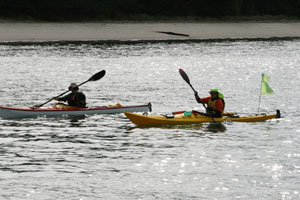 |
| A couple of paddlers on Tauranga Harbour, one with flag, one without. If you can't see the flashing paddles and 20 feet of orange fibreglass plus the fluoro hat, no amount of flag is going to help. |
The debate is continuing amongst kayakers, who in the Auckland region may soon be forced to take measures to make themselves easier to see.
Most do anyway, but the addition of silly flags to a kayak goes a step beyond what should be reasonable. The only time a fluoro flag should be considered advisable is perhaps a fishing kayak, sitting stationery over a fishing spot, especially in swells. In this situation, without flashing paddles above head height and the occasional obscuring by a rolling swell, it is feasible that a speeding powerboat may not have the best chance of spotting a stationery kayaker.
But in all other instances, there's no excuse for a powerboat driver to not be able to see 18-20 feet of fibreglass or plastic, bright flashing paddles and whatever coloured hats, buoyancy vests and other clothing that the paddler is wearing.
If a powerboat cannot see a kayaker in time to avert collision, they're even less likely to be able to see a swimmer, surfer, fallen windsurfer or a log. They certainly would have hardly any chance of avoiding a young girl in the water, just fallen off her water skis – the very scenario that has played out so tragically in the Courts this month.
Powerboaters everywhere need to change their mindset. Might is not right. We need to be always aware that over the next trough could be a vulnerable fellow water user – human or animal – or a hazard. And that those surprises could well be a lot smaller and less visible than a kayak and its paddler.