
 |
Community Pulse with Rosalie Crawford Rise Up Tauranga |
Recently a local real estate agent came to me and said: ‘I've been managing and selling property for 13 years. Every day I go home to my own place, I never do anything for the community and I feel so incredibly selfish, please tell me what I can do to help people who really need it in our city?'
We talked about the challenge of often needing knowledge, training and skills to assist, and how many local organisations have trained skilled workers who understand the privacy and other issues that may surround communities.
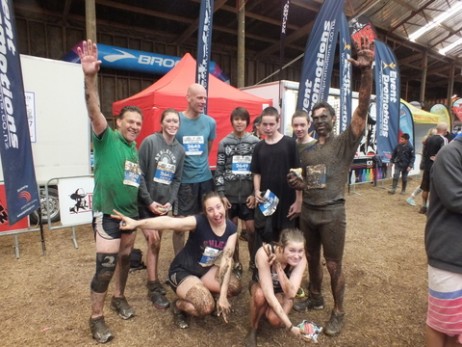
PK mud run 2013. Some Project K students and their mentors travelled to Rotorua to compete in the Tough Guy and Gal Challenge.
The solution seemed quite clear – to support those organisations who are at the ‘coal face' daily. But who are they? Where are they? What are they doing and how do I or other people – immersed in jobs, business, at home or retired – get involved and help them? And why would we want to?
The Foundation for Youth Development is one such organisation. Founded by Sir Ed's friend and climbing companion, Graeme Dingle, and lawyer Jo-anne Wilkinson, in 1995, it's a leader in the field of child and youth development and runs several proven programmes nationwide that lift the skills, self-confidence, motivation and achievements of young Kiwis aged five-18 years.
In the Bay of Plenty, FYDregional programme manager Dan Allen-Gordon is busy looking for more Project K mentors to help teenage students develop and grow.
Mentors come from a wide range of people and backgrounds – plumbers, lawyers, bank managers – basically people from all walks of life. All it takes is someone who cares and wants to help someone else. The commitment is for 12 months, with two days' training on two Saturdays, and then meeting fortnightly with the young person, and every week by phone or other communication. It's shown to be a life changing experience for both the student and mentor.
For the student, Project K has three stages – a three-week wilderness adventure, followed by a 10-day community challenge; then a 12-month mentoring programme, where a trained adult mentor helps support them through their goals for the next year.
Project K has seen students stay in school longer, go onto higher education or into a workplace successfully. The community challenge stage is where they learn to transfer the goal setting and leadership skills and motivation, learned during the wilderness experience, into a community project. Some organisations they've supported are: Avalon, Canteen, Homes of Hope, Riding for the Disabled, or fundraising for a marae rebuild on Matakana Island.
How did FYD start here in the Bay of Plenty? Dan was watching a ‘20/20' programme one night about Kiwi Can and saw it as a robust way to develop youth and grow community.
He started Kiwi Can in 2004, aiming at Year 1-8 students, running the first programme in Opotiki in 2005, followed by delivering a programme in the Western Bay of Plenty in 2006.
Eight years ago it merged with FYD. There are now Western Bay of Plenty 2350 students participating in Kiwi Can each week, learning values and life skills from four teams of FYD staff. Every student in the participating school is involved; and this term the theme is ‘positive relationships'.
Dan says: 'we see many positive outcomes and reductions in negative behaviour. One of our schools just gave us an endorsement, telling us how prior to Kiwi Can, for many years, bullying was an issue in the school community”.
Otumoetai College principal Dave Randell writes of the impact of Project K at his college: 'Recently, I attended the graduation of 10 of our students who had participated. I would have loved to video these young pupils 14 months ago, because on graduation night you could hardly recognise them in terms of who they have become and the extremely positive belief they now had in themselves”.
'They mentioned goals, their attitude to life, they had ambitions and they related to all around them. Their families were thrilled with such a turn around. Gone, in many cases, were the introverted, angry, disillusioned, argumentative, non-focused teenagers. This is an amazing turnaround; and one I am adamant would not have occurred had it not been for Project K.
'Even the adult mentors mentioned that this had been a life altering experience for them and all want to continue with their mentoring as they now believe in what has occurred.”
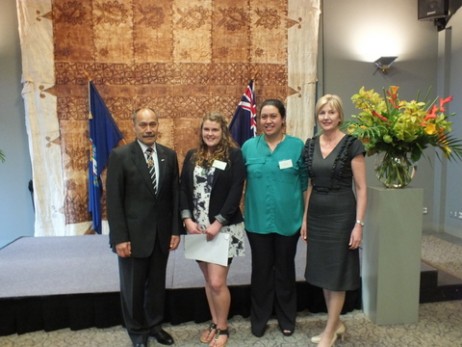
Foundation for Youth Development excellence awards last October saw Otumoetai College Project K Excellence student Jessica Collins receive an award at Government House.
There are now 11 schools involved with both the Kiwi Can and Project K programmes; and a great demand from more schools in the Western Bay of Plenty, as well as requests from schools in Whakatane, Rotorua and Kawerau for it to start there.
In New Zealand there are close to 19,000 young people in the programmes.
FYD also has a youth offender programme calledMentoring Youth New Direction, which has achieved 72.4 per cent reduction in the severity and frequency of re-offending. The national average(2) is 37.3 per cent.
How effective are the FYD programmes? In April 2013, Paula Bennett and FYD's Graham Dingle released the Growing Great Futures Report (1), an economic analysis of the benefit of FYD to the New Zealand economy.
It shows that investing in FYD brings a 7:15 economic return. Comparing the economic value of the FYD programmes to the cost ratio of a ‘road of national significance', which is estimated to be 1.8, this implies that for every dollar invested in FYD activities it is expected to result in a long-term benefit to society of $7.15.
So extrapolating that means a billion dollar FYD project would result in more than $7 billion back into the NZ economy in terms of increased productivity, at risk behaviours being addressed, lowered court and prison costs, and impacts on health and unemployment to name a few.
The report stated there are three types of economic benefits emanating from FYD programmes:
- Programmes like MYND will have a direct impact in reducing criminal activity and hence reduce the costs associated with crimes, both through costs to victims of crime and the cost of the justice system.
- Individuals who enter adulthood with better education, in better health, and with a greater attachment to society, are more likely to find better paying employment.
- In addition to the private benefit to individuals there is likely to be a positive spill over for the rest of society. This might materialise, for example, through a lower level of beneficiary dependence or an efficiency gain through higher levels of labour market participation.
The report's interpretation is the FYD programmes are likely to be cost effective interventions that will both promote economic efficiency and reduce lifetime inequality.
Other FYD programmes are: Career Navigator, connecting teenagers in schools into the work force; and the STARS programme for Year 9s, which is about peer mentoring.
Unfortunately, there are no funds available for Dan and his team in the Bay of Plenty to implement these locally. Dan says: 'There's such huge demand for what we are doing already. All our programmes are long-term in order to achieve long-term outcomes; and there may be someone out there who can access a way that we can fund one of these other programmes”.
As well as individuals becoming mentors for Project K, or voting for FYD at local Z Stations at Palm Beach or Bethlehem during March, local businesses and business networks can sponsor programmes and get involved as volunteers with the Kiwi Can Acts of Kindness programme. This year at least 2000 students will be out doing acts of kindness, allowing them to put into practice what they've been taught in the classroom, and building relationships in the community. (3)
If you'd like to find out more about becoming a mentor, or your business would like to sponsor a programme or get involved in the Kiwi Can Acts of Kindness, please contact Dan on 021 992 613 or email dan@bop.fyd.org.nz
To be connected to Rise Up Tauranga go to the Facebook Page ‘Rise Up Tauranga' or email riseuptauranga@gmail.com.
Rosalie Crawford is a medical scientist and lecturer. Phone 021 072 8255, email Rosalie.crawford@xtra.co.nz, Skype: Guavablue, Facebook/Twitter: Rosalie Crawford.
References:
(1) Growing Great Futures Report Executive Summary: http://www.fyd.org.nz/Portals/0/Docs/Growing%20great%20futures/Executive%20summary%20-%20website.pdf
(2) The Salvation Army's Annual State of the Nation Report: http://media.nzherald.co.nz/webcontent/document/pdf/20147/Striking%20a%20Better%20Balance%20-%20Final%20Web.pdf
(3) FYD Bay of Plenty: http://www.fyd.org.nz/Programmes/Regions/BayofPlenty/Tauranga.aspx
(4) FYD Facebook page: https://www.facebook.com/fydnz