
 |
Mike Chapman NZKGI Chief Executive |
The sole driver for success is what kiwifruit growers earn.
If growers don't earn enough to cover their costs and debts to make a reasonable profit, the industry will fail. This is true for any industry.
The ingredients required for the kiwifruit industry's success are:
• Retention of the industry's marketing system, known as the Single Point of Entry.
• Robust biosecurity systems to protect our industry from pest and disease incursions; and rigorous processes to provide effective and timely responses, should an incursion occur.
• Market access and tariff reduction – for example, the kiwifruit industry pays a 45 per cent tariff for fruit going into Korea. Our main competitor in our Southern Hemisphere season, Chile, pays nothing – equalling a zero per cent tariff.
• Access to world-leading varieties that are Psa and pest/disease tolerant.
• Access to water and land suited for kiwifruit orchards that can be sheltered from the wind.
• Succession planning and development of industry skills and leadership.
• Access to reliable and skilled labour, particularly during peak times (harvest and
winter pruning).
• Access to capital to buy and develop orchards.
• Good infrastructure throughout the rural growing areas – for example, roads, water, broadband.
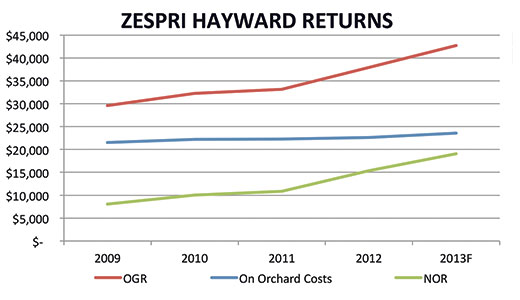
Maintaining the Single Point of Entry marketing system is the key ingredient for the industry's success, as it has the ability to generate increasing returns to counter the increased cost of growing, picking, packing and shipping our kiwifruit.
The trend since 2009 is shown in the attached graph for Hayward green kiwifruit. The figures in this graph are averages. The key point to take out of the graph is increasing returns are needed for the economic good health and survival of the kiwifruit industry.
Returns
Orchard Gate Return, or OGR, is the money growers receive after paying their postharvest operator and Zespri for all costs associated with picking, packing, cool-storing, shipping and selling their fruit.
Net Orchard Return , or NOR, is what is left after their orchard costs are met. What is left over must service debt, orchard upgrading and pay the orchardist for growing the fruit.
The kiwifruit industry's marketing system was created by the Kiwifruit Export Regulations 1999. The regulations appointed only one exporter for kiwifruit exported outside of Australia; this exporter is Zespri. Other exporters can apply for collaborative marketing through Kiwifruit New Zealand. On average a little less than two million trays yearly are exported by collaborative marketers, so the main exporter is Zespri.
While this marketing system is referred to as the Single Point of Entry by the industry, it is not a legal term. It describes the marketing system.
The beneficiaries of SPE are kiwifruit growers who supply Zespri; and this is because it gives Zespri the majority of NZ kiwifruit to export.
Scale
This scale means Zespri has, for example, the size and power to negotiate favourable shipping rates; take foreign exchange positions for future years – taking the sting out of the high NZ dollar; run one supply chain, saving the cost of running many supply chains; ensure our kiwifruit is consistently of the highest quality; be able to back our kiwifruit's quality on the supermarket shelves; and to market and distribute our kiwifruit generating superior grower returns.
The SPE therefore needs to be retained, as it is a key ingredient of the kiwifruit industry's success.
The views expressed in this article are those of the author and not necessarily the views NZ Kiwifruit Growers Incorporated.