
 |
Weather Eye with John Maunder |
There's an excellent website compiled and updated monthly by Dr Ole Hilum, who is a Danish professor of physical geography at the University of Oslo, and adjunct professor of physical geography at the University Centre in Svalbard.
You can check it out at: http://climate4you.com
His academic focus includes glacial and periglacial, geomorphology, and climatology. The following item is compiled from his website.
Planet Earth has an age of about 4600 million years.
Most, if not all, of geological divisions are based on the recognition of environmental changes affecting the entire planet. That is past global climate changes, which has been the rule for the entire history of Earth – not the exception.
If each year of the 4600 million years is represented by one millimetre, the entire period would be about 4600 kilometres long.
On this scale modern humans would appear within the last 200 metres, the polar bear within the last 150 metres, and the entire global meteorological record since about 1850 would take up the last 160mm.
From time to time the planet has been affected by millions of years with a relatively cold climate, each such period leading to a long succession of glacial and interglacial periods. During the last couple of millions of years, Earth has been in such a cold stage.
The last, until now, ice age ended about 11,600 years ago, and we're living in a so-called interglacial period, until the next ice age will begin sometime in the future.
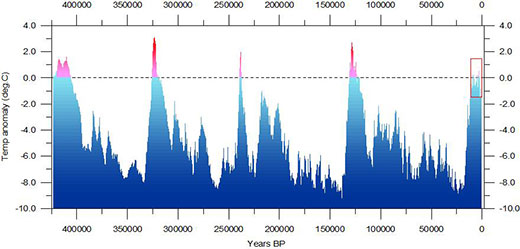
The last four glacial periods and interglacial periods are shown in the diagram, covering the last 420,000 years in Earth's climatic history.
The reconstructed global temperature shown, which covers the last 420,000 years, is based on the Vostok ice core from Antarctica.
The records span during four glacial periods and five interglacials, including the present. The horizontal line indicates the modern temperature.
For further information on climate matters see https://sites.google.com/site/climatediceandthebutterfly/