
 |
Weather Eye with John Maunder |
The latest global average temperatures of the troposphere – those observed from National Oceanic and Atmospheric Administration satellites – are computed by the University of Alabama at Huntsville in the United States.
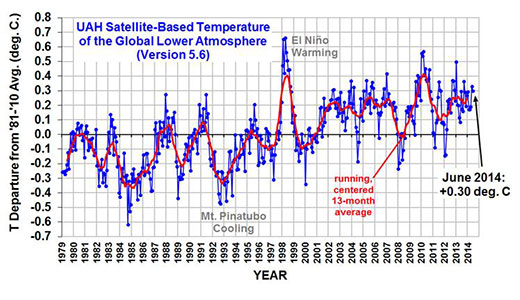
Of significance there appears to be very little change in the overall global temperatures during the last 15 years.
The chart shows since 1979, when reliable satellite observations have been available, there has been little overall trend.
However, that's except for a small warming trend from the average temperatures during the 30-year period from 1981-2010 in the temperatures in troposphere, apart from ‘normally expected' variations.
The data for 2011 is January 0.0 degrees Celsius, February -0.02, March -0.10, April +0.12, May +0.14, June +0.32, July +0.38, August +0.33, September +0.29, October +0.12, November +0.12, December +0.10 degrees.
The data for 2012 is: January -0.09 degrees, February -0.12, March +0.11, April +0.29, May +0.29, June +0.37, July +0.28, August +0.34 , November +0.28, December +0.20 degrees.
The data for 2013 is: January +0.50 degrees, February +0.18, March +0.20, April +0.10, May +0.07, June +0.30, July +0.17, August +0,16, September +0.37, October +0.29, November +0.19, December +0.23 degrees.
The data for 2014 is: January +0.29 degrees, February +0.17 degrees, March +0.17 degrees, April +0.19 degrees, May +0.33 degrees, and June +0.30 degrees Celsius.
The coolest months since 1979 were September 1984 with minus 0.49 degrees Celsius and November 1984 with minus 0.42 degrees Celsius.
The warmest months were February and April 1998, both 0.76 degrees Celsius.
The chart shows the El Nino warming in the 1998 period and the Mount Pinatubo, volcanic, cooling during 1992-1993.
For further details on climate matters, see https://sites.google.com/site/climatediceandthebutterfly/