
 |
Weather Eye with John Maunder |
Arctic sea ice extent declined at a fairly rapid rate through the first three weeks of July, but the loss rate then slowed due to a shift in weather patterns.
In Antarctica, the advance of sea ice nearly halted for about a week in early July, and then resumed. At the end of the month, Antarctic extent was at or near a record high for this time of year.
The National Snow and Ice Data Centre, in Boulder, Colorado, has an extensive website on Arctic and Antarctic sea ice. For details, see: http://nsidc.org/data/seaice_index/
In the Arctic, the July 2014 average ice extent was 8.25 million square kilometres. This is 1.85 million square kilometres less than the 1981 to 2010 average for July.
July 2014 is the fourth lowest Arctic sea ice extent in the satellite record, with 340,000 square kilometres more than the previous record lows in July 2011, 2012, and 2007.
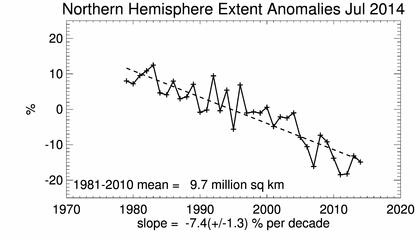
The monthly linear rate of decline for July is 7.4 per cent, per decade.
Arctic sea ice reached its annual maximum extent for 2014 on March 21.
Overall, the 2014 Arctic sea ice coverage was the fifth lowest in the 1978-2014 record.
In contrast, Antarctic sea ice reached its annual minimum for 2014 on February 23.
This is the fourth highest Antarctic minimum in the satellite record. This continues a strong pattern of greater-than-average sea ice extent in Antarctica for the last two years.
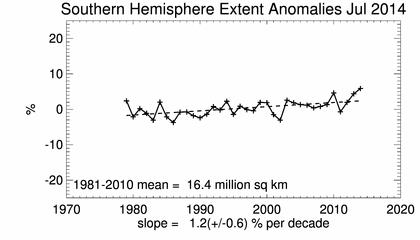
Graphs of the extent of the Northern Hemisphere and Southern Hemisphere ice – updated to July 2014 – from the above website are shown below.
These show from 1979 to 2014 the Northern Hemisphere ice extent decreased at the rate of 7.4 per cent per decade, compared with an increase of 1.2 per cent per decade during the same period in the Southern Hemisphere.
For further information on the climate science scene see: https://sites.google.com/site/climatediceandthebutterfly/