
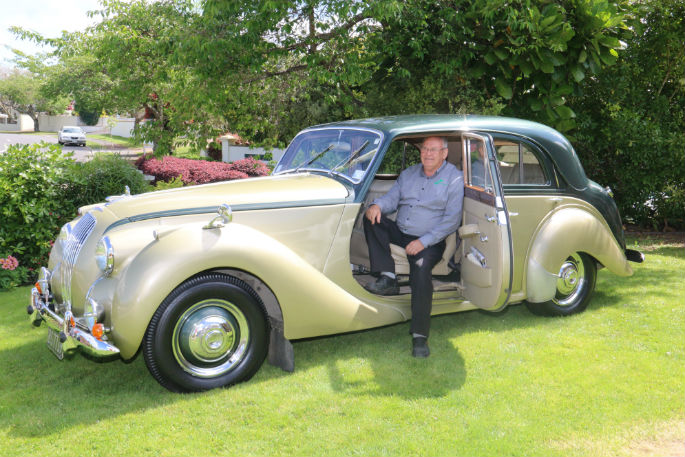
It certainly wasn't love at first sight.
'I thought she was…umm…heavy-arsed looking,” says John Redding. ‘She' is a car.
'A big-bottomed girl,” corrects Lindsay Redding, wife, co-owner, co-minder, co-caretaker of perhaps Bethlehem's most stylish, and sophisticated of ladies on the road, a 1951 Lagonda 2.6 litre four-door saloon.
Sometimes it's not the idea but the words that are the problem. The Lagonda is thickset, set squarely on the road, or in this case on John and Lindsay's front lawn under a fluttering New Zealand flag. Thickset but quite regal and with an aluminium torso that makes her deceptively light.
Despite his initial misgivings John's feelings for ‘she' have deepened. 'Everything about that car is quality, just taking her somewhere is very satisfying.” He talks warmly, like a proud dad.
From the moment the doors click – they don't slam – to the moment the straight six-power plant ‘cackles' and propels you to 70m/hr or 110km/h in little more than 17 seconds, the Lagonda is special.
The clock set in the burr walnut dash peaks at 90m/hr. 'I have already had it well over the speed limit, but I better not say that. Past 70m/hr, put it that way.” A thoroughbred needs exercise. 'But not with me in it,” says Lindsay.
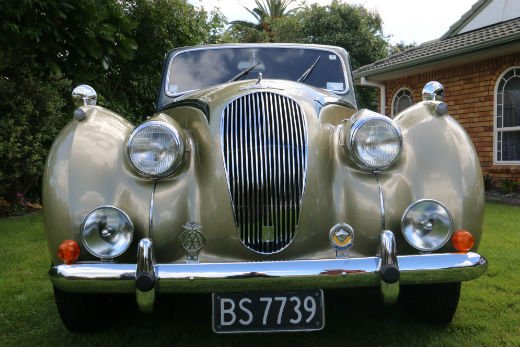
And there is good breeding here, quite exceptional and exclusive.
Lagonda is a British luxury marque – established at the beginning of last century and owned by Aston Martin since 1947. Of that company's DB5 was James Bonds choice of wheels.
Other big industry names had their fingerprints all over the Lagonda – like a certain Walter Owen Bentley, who designed the engine. And today a pristine example of his workmanship is sitting on that Bethlehem front lawn beneath that fluttering NZ flag.
And we are standing there worshipping the beautiful flowing lines, touching, stroking and making all the appropriate adoring sounds that proud parents do. Everyone loves a vintage car, especially one with about nine separate components woven into just one mudguard.
'Do you know the origins of Lagonda?,” asks Lindsay. It's apparently a native American Shawnee name for Wilbur Gunn's home town in Ohio, Gunn being the founder of Lagonda.
This car was derelict when pulled from a building 40 years ago. 'It was a hell of a mess,” says John. But even as a wreck it was a blessed when it fell into the hands of Bill Janes of Greerton.
'An incredible man,” says John. 'They often say it's the magic of the man, he creates things from nothing.”
And when John and his wife heard one bit of Bill Janes' 'magic” might be for sale he made a pitch for it after cashing up a 1928 ‘gangster' Hudson and a front wheel drive Triumph Toledo.
It was the brakes that did it for the Hudson. 'One day I would go into the testing station and get a Warrant [of Fitness] and the next day the car would have no brakes at all. This love-hate relationship went on for years until I couldn't take it any longer.”
The Hudson is now in an English museum and the Lagonda occupies its space in John's garage.
'Bill Janes understood our love of cars; and, secondly, I promised it would never leave the country under my ownership. It will be handed down.”
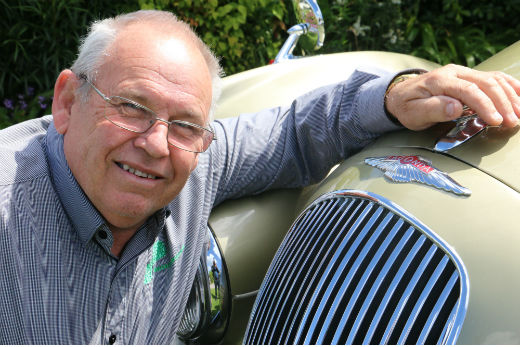
Of course money was in the equation too. So what value do you apply to rare? Rare because there's possibly just one other drop head coupe, the sports version, here in NZ and just 18 coupes and saloons worldwide.
'Does the money really matter?” says John. He makes it sound unsavoury. Suffice to say it was a gentlemen's agreement and he is staying stum. 'But I can I can tell you they are worth 90,000 pounds or NZ$150,000 in England.”
And judging by the photographs online, John and Lindsay's Lagonda is apparently one of the nicer ones, if not the nicest.
They still make Lagondas, like the Taraf Lagonda. Roughly translated from Arab, ‘Taraf' means ultimate luxury. A 5.9 litre V12 with a rocket propelled price tag at 696,000 British pounds or nearly NZ$1.2 million. Luxury isn't cheap.
But even luxury can break. 'The hardest thing with a Lagonda like ours is the motor,” says John. 'They basically die and you can't get the bits. But we are blessed because we do have the bits.”
And if there is an accident, regardless of whose fault it is, there's little chance of it being repaired. 'It wouldn't be something you could just take down to the panel shop and say: ‘Fix it' because there aren't the skills around.”
The Reddings feel 'kind of special and kind of threatened” when they are out and about in the Lagonda. Special because people stare and appreciate, but threatened? 'When people are overtaking, rather than finish the manoeuvre, they drive alongside on the wrong side of the road to see you from all angles. They have seen the back end enough.”
John says there is often a misconception about vintage cars. 'They see one and they see dollars signs. But I am just a working man.” One with a passion and a duty.
Like most vintage cars around today, John says they will last forever, barring some catastrophic event. 'And so we are just the caretakers for the moment. That is both a privilege and a responsibility.”