
It looks like a book, it isn't a book but still tells a wonderful story.
'This sort of thing's not really our business,” says Stephanie Smith, archivist in the Tauranga City Library's Wahi Rangahau research collection. 'But it's special and I am delighted to have it.”
The ‘thing' that looks like a book but isn't a book lives amongst all of the New Zealand room's paper-based records of the heritage of Tauranga – a chunk of wood, a 30cm by 30cm piece of cottonwood tree with the bark intact, which gives it the appearance of a book.
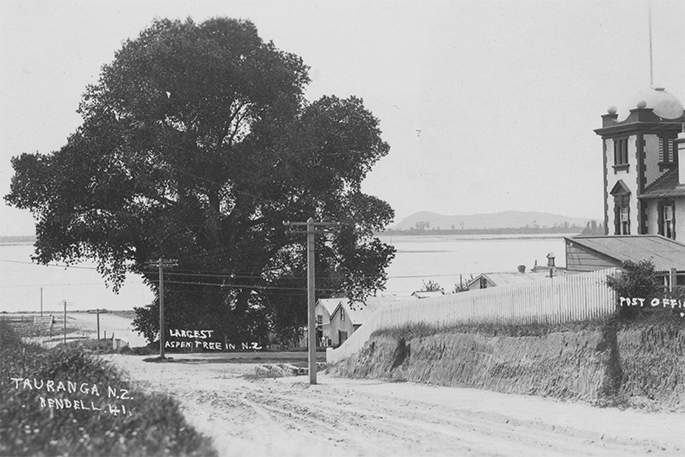
And the ‘thing' has particular relevance today as the city grapples with the future of a city green space bearing the misnomer Aspen Reserve.
Misnomer because the grand tree, which once dominated the reserve on the corner of McLean and Willow streets, and the city skyline, wasn't an aspen and it doesn't exist. It's long gone, chopped down in June 2011.
And when the tree was chopped down in debatable circumstances, the seemingly reluctant and sensitive arborist gave 'the chunk”, this little bit of history, to Stephanie as a keepsake, a memento.
'There were a lot of people who wanted the tree down,” says Stephanie. 'But equally there were a lot of people who didn't.”
The tree was a Poplar Deltoides Virginiana, an American hardwood more commonly known as a cottonwood. And those who wanted it down, didn't like the leaves it dumped and certainly didn't like the catkins, the downy, fluffy seeds which become pollinated by the wind for long distances.
'They blew everywhere and got into everything,” says Stephanie. The catkins got under peoples' skin and up their noses and they complained long and hard.
The cottonwood had several stays of execution. Then, in what was almost an act of defiance and retribution, the tree dumped a substantial limb on a car. No-one was hurt but the tree had sealed its own fate. Down it came.
The origins of the tree are uncertain. 'One story has it that in 1864 a soldier from the Battle of Gate Pa stuck a stake in the ground to tether his horse and the stake took root,” says Stephanie. 'But Tauranga is very romantic and has to relate everything back to the Battle of Gate Pa. This would be stretching the truth because a switch of this particular species just wouldn't have been available at that time.”
Stephanie says the tree was more likely planted by the armed constabulary, which carried out a lot of public works in the late-1860s.
Either way, it was an impressive specimen – they can grow to 40 metres – and it dominated the skyline of the time. 'So large, so spectacular, so old, it was a corker.”
The trees at The Elms, the Norfolk Pines, which were known as the Archdeacon's Sentinels because they assisted ships navigating the harbour, Stephanie says they lacked the grandeur of the cottonwood.
So what of the 1300m2 Aspen Reserve? It has a fairly colourless history, no public hangings, no rabble rousing, no public gatherings or union meetings, no brawls.
'Just gentlemen of the road,” says Stephanie, referring to the old-time vagrants who used the park to gather and drink. Generations of gentlemen of the road it seems because when The Weekend Sun wandered through Aspen Reserve this week there were empty Smirnoff bottles and empty Heinekens scattered about.
A local gym uses the Aspen Reserve for bootcamp and the amphitheatre has been used as a concert venue. But now the Tauranga City Council is saying to the community: ‘It's your park so we want your thoughts'. ‘Do you use Aspen Reserve at the moment? How? And if not why not? And how would you like the Reserve used in the future?'.
Talk to the council at the Aspen Reserve on Thursday, February 9 from 11.30am-1.30pm or Friday, February 10 from 11.30am-1.30pm. The wet weather alternative is the Tauranga City Council office on Willow St.
'If I know anything about Tauranga they will change the name of Aspen Reserve for obvious reasons but people will still call it Aspen Reserve. Just like Red Square, which is no longer red,” says Stephanie.
The Aspen Reserve is gazetted as a public reserve so it will stay a public reserve. 'It's historically important,” says Stephanie. 'And we need to hang on like grim death to any open green spaces because this town is only going to get more built up.”