
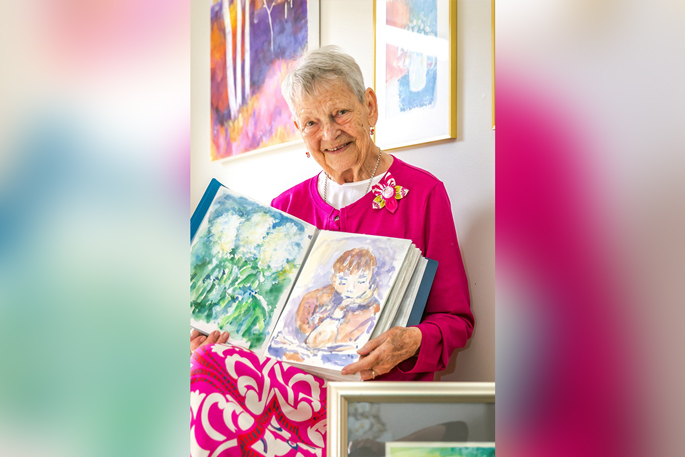
When artist Win Mcgreggor’s eyesight began to deteriorate, she reluctantly set aside her brushes and believed her painting days were over.
It was about a decade ago, when she began making brooches, that when things started to falter.
The 90-year-old has macular degeneration, a progressive, age-related eye disease affecting the central retina (macula), leading to blurred vision, distorted straight lines, and, if untreated, significant central vision loss.
Three years ago she gave up painting completely – now she’s done a U-turn. A set of watercolours from her daughter Diane Lockward, also an artist, suddenly reignited her desire to paint.
Adapting to her new way of seeing, Win – who still has peripheral vision – has embraced a different style of art.
“Now because I can’t see where I’m putting the brush, the paintings have turned out to be quite abstract and people seem to like them,” she said.
For two years, Win has called Arvida Bethlehem Views retirement community in Tauranga her home.
“I didn’t want the family to worry about me so I came in here and it’s been wonderful,” she said.
Win told The Weekend Sun her painting mornings fly by as she is regularly served coffee by the team and they stop and chat about her paintings.
“Our approach is very resident-led so we encourage residents to be as independent as possible for as long as possible,” said Arvida Bethlehem Views Village manager Jane Verry.
“The team don’t have to help her with painting; she likes to set everything up in her room herself.”
Even as a child growing up on a farm in Hamilton, Win’s creative spirit was clear. “At primary school I sketched a side view of the teacher and it sort of looked like her.”
Although she didn’t pick up painting seriously until after raising her family, Win found immense joy in it, joining an art group and experimenting with subjects like roses and landscapes.
Her early works were modest but they marked the beginning of a strong enthusiasm for painting.
Now each morning, after a walk, Win is living life her way by setting up her brushes and watercolours in a dimly lit room – ready to lose herself in the flow of creativity.
“I’ve surprised myself with just blobs of paint and so I’ve kept going. I actually like this new abstract way of painting more than the still life I did years ago.”
Though her peripheral vision limits her ability to capture eyes or fine details, Win uses time at night to think about her next canvas idea, whether it’s a horse or fresh flowers.
“Once I grab my brushes and watercolours the hours just slip away. I just can’t wait to get painting.”