
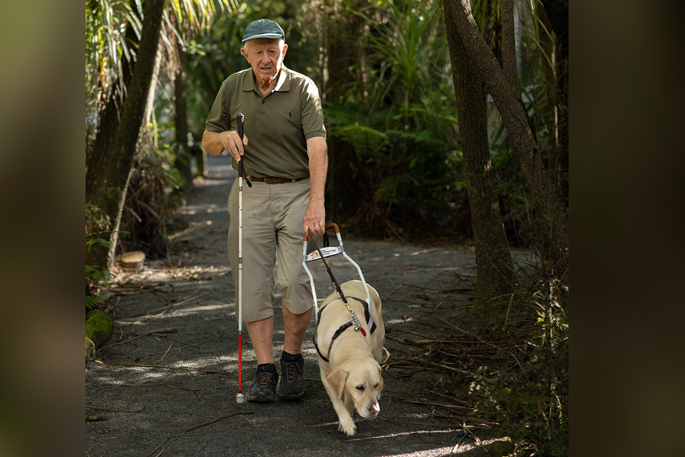
Four service dogs have been selected by artist Sam Allen to be featured in a mural at Memorial Park. The Weekend Sun is running a series of six ‘Service Dog Mural’ stories. Today’s Service Dog Mural #2 story is about David Monk and his dog Easton.
For David Monk, independence comes on four steady legs.
Monk has been totally blind for about 30 years after being diagnosed with a severe form of glaucoma at age 40. The condition gradually deteriorated across a decade until he lost his sight completely. Before that, he had been farming and later managing his own orchard – work he continued to oversee for many years, even after his vision declined.
Easton, a six-year-old male Labrador with a small trace of golden retriever in his lineage, is Monk’s fourth guide dog. He has been by Monk’s side for the past two years, reallocated after his previous handler was unable to continue with him following a dog attack. The timing was right – Monk’s previous guide dog had just retired.
Close connection
Guide dogs typically work until about age 10 or 11, meaning handlers form deep bonds during eight or nine years before saying goodbye and beginning again with a new partner.
“You do develop a close connection,” Monk said simply.
Easton now guides Monk through daily life at Althorp Retirement Village, where the pair live. The village has gentle hills, bush tracks and walking paths – routes Easton knows intimately. They walk once or twice a day for exercise, and Easton confidently navigates every corner.
“It’s just so much easier to get around with a dog once he’s trained rather than a white stick,” Monk said.
While a cane can help with mobility, it’s slower and far more limiting. A guide dog offers fluid movement and assurance. “This fellow – he never gets lost.”
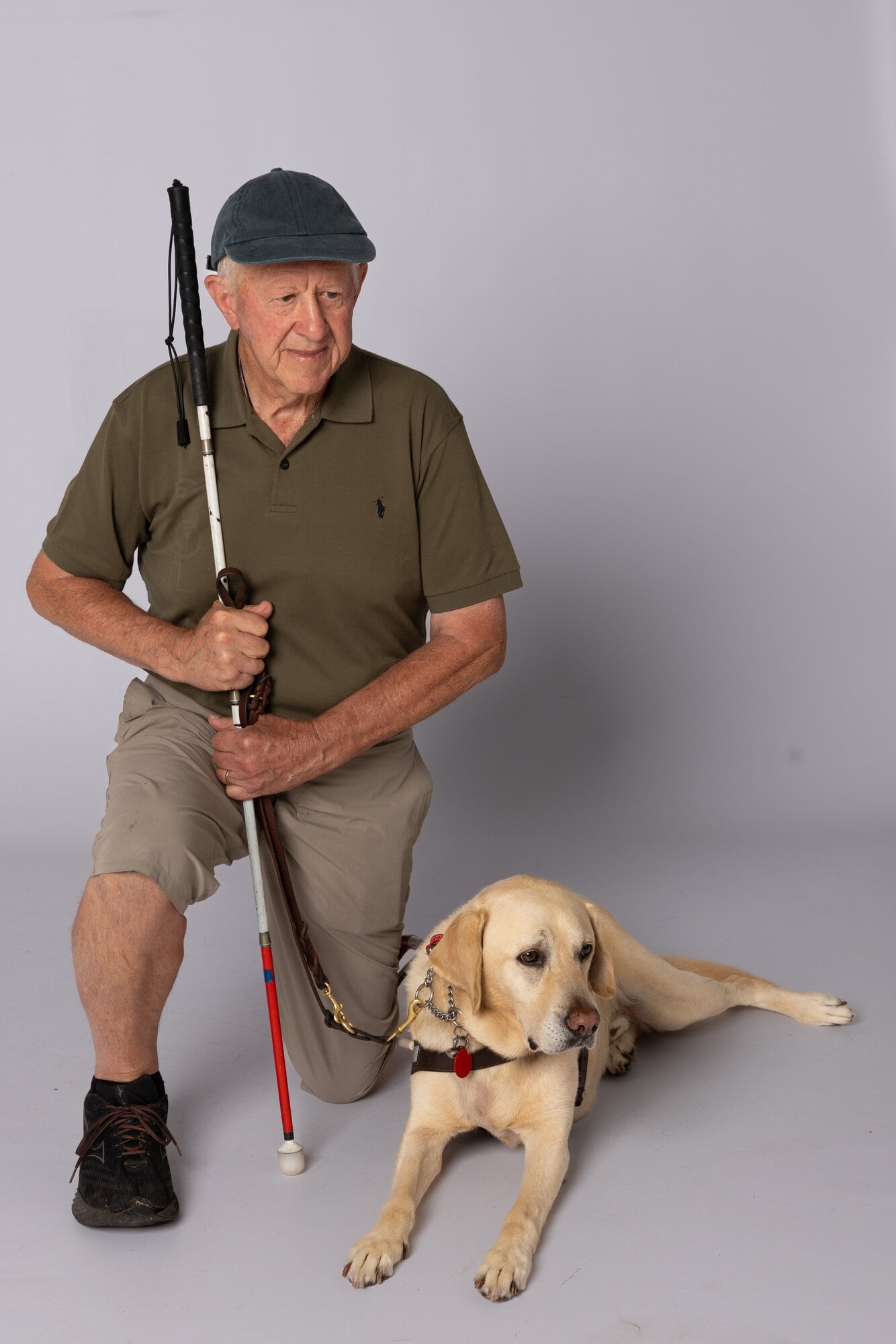
David Monk with his guide dog Easton. Photo / Nicholas Charles
This month is also Guide Dog Puppy Appeal month. According to the Blind Low Vision NZ IDI Report, the indicative age of onset for people with severe vision impairment is 44. As more New Zealanders face a life with vision loss, some face years-long delays waiting to be matched with a guide dog due to ongoing funding gaps.
It costs $175,000 to raise, train, and support one guide dog across its working life. Guide Dogs typically work for 8-10 years before retirement. In some cases, if a guide dog has been attacked by a roaming dog, they may not recover fully to be able to go back to work again.
Longstanding gap (sidehead)
Blind Low Vision NZ chief executive Andrea Midgen said the waiting list reflects a serious and longstanding gap between need and funding.
“Every person on the waiting list is trying to live, work, study and connect with their community with fewer tools, more effort, and a lot more risk. A guide dog can give someone the confidence, safety and independence that many of us take for granted. But right now, funding shortages are holding too many people back. We urgently need support to train more puppies and reduce these long waits,” Midgen said.
With confidence
Easton is not just a working dog; he is a constant companion, warmly greeted by fellow residents wherever he goes. His calm reliability allows Monk to move through the world with confidence.
Beyond daily routines, Monk has led a full and active life. He had been heavily involved in blind sport over the years, particularly blind bowls, and had also tried blind sailing. Even now, he continued to play bowls within the village, assisted by a director who helps orient him – the rules remain the same, but teamwork makes it possible.
The opportunity to be part of Sam Allen’s mural came via Blind Low Vision NZ’s Guide Dog Services, who were contacted to help find a suitable dog and handler.
Monk admits he’s not entirely sure what the finished artwork will look like – whether it will feature only the dogs or their handlers as well – but he was especially intrigued to hear it may include raised elements. “In my case, I’ll probably be feeling it,” he said with quiet humour.
Profound
For Monk, that detail matters. A mural that can be experienced through touch as well as sight reflects something profound about partnership and access. Just as Easton opens pathways each day, the artwork promises to do the same – ensuring everyone, regardless of vision, can share in the tribute.
When the mural is unveiled, many will admire it visually. Monk will experience it differently – tracing its shapes by hand, standing beside the dog who helps him navigate life with dignity and independence.
To support the 2026 Guide Dog Puppy Appeal, visit: BlindLowVision.org.nz or call 0800 DONATE (0800 366 283).
Next week, The Weekend Sun will showcase the second of the four service dogs chosen for the mural.