
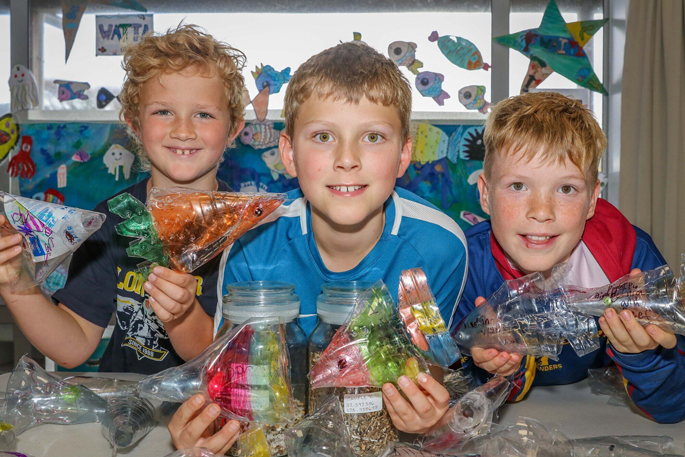
More than 75 pupils from Waihī Beach School have created fish sculptures from discarded waste as part of a hands-on environmental art project highlighting plastic pollution in the Pacific Ocean.
The tamariki worked alongside internationally respected Pacific cultural and creative leader Stan Wolfgramm in a workshop delivered as part of the Forgotten Promises Project – Ocean Conservation Art Installations, an initiative led by Sustainable Waihī Beach.

Te Ara – The Cook Islands Museum of Cultural Enterprise co-founder Stan Wolfgramm at Waihī Beach School. Photo / Kelly O’Hara
The pupils used discarded plastic bottles, recycled materials and recovered waste, including small plastic pellets that continue to wash ashore at Waihī Beach after the MV Rena grounding.
The ongoing presence of these materials is a visible reminder of the long-term environmental impacts on coastal ecosystems, Sustainable Waihī Beach founder Pippa Coombes said.
“The individual fish sculptures will be brought together to form a large-scale hanging mobile installation designed to raise awareness of marine plastic pollution and encourage community discussion about ocean protection.”

Waihī Beach School pupils Minnie Gilmore, 8, and Tatum Coll, 8, working on a fish sculpture. Photo / Kelly O’Hara
Coombes said the hope is the completed work will be displayed in regional libraries and community spaces as an educational tool focused on sustainability, marine conservation and guardianship of Te Moana-nui-a-Kiwa, the Pacific Ocean.
Wolfgramm is visiting Waihī Beach as part of a wider Pacific partnership involving Sustainable Waihī Beach, local hapū kaitiaki Te Whanau a Tauwhao, and collaborators working on environmental education and ocean guardianship initiatives across Aotearoa and the Cook Islands.

Reon Tuanau (left) from Te Whanau a Tauwhao Hapū, Waihī Beach School principal Rachael Coll, Te Ara – The Cook Islands Museum of Cultural Enterprise co-founder Stan Wolfgramm, and Sustainable Waihī Beach co-ordinator Pippa Coombes displaying Moana Pasifika, an interactive digital app. Photo / Kelly O’Hara
During his visit, Wolfgramm also spoke about the development of Moana Pasifika, an interactive digital platform designed to combine indigenous knowledge systems with environmental learning and conservation action.
“The app is currently in final-stage development, and is designed as an interactive ‘Ocean Guardian’ experience where users create and restore their own virtual ocean sanctuary,” Wolfgramm said.

Waihī Beach School pupils Avery Pearse, 8, and Arna Richardson, 8, creating a fish sculpture. Photo / Kelly O’Hara
He said the platform, which combines education, conservation and indigenous knowledge systems, encourages users to reconnect with the ocean through restoration-based gameplay and environmental action.
“Users can populate and nurture their own marine environments with species and ecological icons relevant to their local region, from coral reefs and tropical marine life through to local taonga species such as the kororā/little blue penguin found along the Waihī Beach coastline,” Wolfgramm said.
“A small contribution attached to each icon is fed back to the organisations doing the real conservation mahi, helping sustain this vital work at a time when funding is increasingly hard to secure.”

Waihī Beach School Year 5 and 6 Taiao Environment and ICT Champions with (from front left) Reon Tuanau, Rachael Coll, Stan Wolfgramm and Pippa Coombes. Photo / Kelly O’Hara
The kaupapa behind the platform is based on the belief that people protect what they feel connected to. Through storytelling, conservation challenges, and collaboration with indigenous and environmental organisations, the project aims to inspire future ocean guardians across the Pacific.
The platform is being trialled by environmental student leaders at Waihī Beach School to understand how rangatahi engage with digital tools for environmental learning.

Pupils Jett Drummond, 7, and Kayden Tuffery, 8, show off a fish sculpture at Waihī Beach School. Photo / Kelly O’Hara
Waihī Beach School principal Rachael Coll said the visit had provided a meaningful practical opportunity to connect culture, creativity and environmental action.
“This kaupapa is about reconnecting people to the ocean through creativity, storytelling and action,” Coll said. “The Pacific Ocean connects all of us, and projects like this allow our communities to become part of something much bigger than themselves while understanding the real impacts of plastic pollution on our marine environments.”
Coombes said the collaboration reflects the growing importance of Pacific-led partnerships and indigenous approaches to environmental wellbeing, especially for future generations facing the impacts of climate change, conservation challenges and marine degradation.

Waihī Beach School Year 3 and 4 Te Repo Class proudly display some of their creations. Photo / Kelly O’Hara
She also highlighted earlier conservation work supported through the partnership, including funding for high-tech predator control traps installed in the upper reaches of the Takuvaine Valley cloud forest ecosystem in collaboration with the Te Ipukarea Society.
“These were the first traps of their kind to be installed in the Cook Islands, helping protect vulnerable ground-nesting seabirds in high-altitude ecosystems more than 400m above sea level,” Coombes said.
“These initiatives reflect an exciting and growing Pacific-led commitment to practical conservation partnerships, knowledge sharing and collective guardianship of our shared ocean and island ecosystems.”