
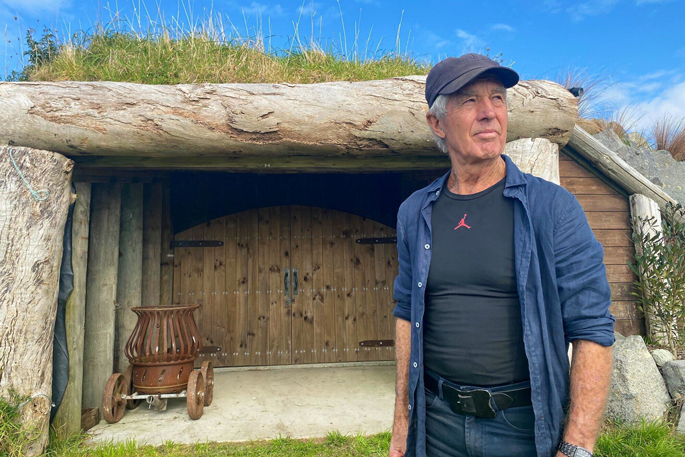
Hidden in a hillside above Te Puna is something you would never expect to find on a working farm.
Step through curved wooden doors and you enter an underground space carved deep into the earth – part workshop, part retreat, part invention lab. Inside are thick timber beams, a blacksmith’s forge, a bar, dining area and kitchen, and a waterfall just outside that hums quietly in the background.
It is the creation of John Carmichael, a farmer who decided that, if he needed a space like this, he would simply build it himself.
“It started when we were doing a small development up there,” Carmichael says, gesturing up toward the hill. “The digger was already on-site and I thought, ‘Well … now’s a good time – dig me a bloody big hole in this hill’.”

John Carmichael turns his blacksmith's fire into a barbecue. Photo / Kelly O’Hara
That hole became something far more ambitious. Cut roughly 15 metres into the side of the hill and about 8 metres wide, the space was excavated, reinforced with a retaining wall, lined with timber and concrete, and then engineered with heavy beams spanning the roof. The whole structure is covered and concealed under around a metre of earth.
“It’s basically like an old silage pit, but turned inside out,” he says. “We just kept building from there.”
What sits there now is a fully functional cave, complete with power, lighting and water. A cable runs nearly 300 metres from a pump shed down the hill to supply electricity.
Carmichael is quick to point out it was properly engineered. “We got advice on the structure and then overbuilt it. Bigger posts, stronger than required. I wanted it safe – 100% safe.”

Inside the cave is a large space with workshop, forge, bar, dining area and kitchen. Photo/ Kelly O’Hara
Inside, the space feels more like a handcrafted lodge than a farm building. Massive timber beams stretch overhead. Rustic steel artwork hangs on the walls alongside salvaged farm machinery and pieces of wood shaped into sculpture. A small lounge – just four chairs tucked into an alcove – sits beside a photograph of the surrounding farm.
There is a blacksmithing forge, complete with anvils, vices and tools. There is also an old shearing plant, still used on occasion, and a sharpening grinder that once came from a shearing station in the Kaimai range.
Then there is the unexpected twist: the forge converts into a barbecue.
“When we’ve had a day working and we’re all done, we just lift the plate off and turn it into a barbecue,” Carmichael says. “You’ve got all that heat there anyway – it’s a shame to waste it.”
Outside the entrance, a large table made from macrocarpa overlooks sweeping views across the Bay of Plenty. On a clear day, Carmichael says you can see from the Coromandel to White Island.
“It’s pretty special up here. No houses in front, just open views. You can sit out here and it’s just … quiet.”

The view from John Carmichael’s cave in Te Puna. Photo / Kelly O’Hara
But the cave was never meant to be a tourist attraction. It is, he says, a place for friends, family and the occasional celebration. Birthdays, pony club gatherings, small events – nothing commercial.
“We didn’t build it for that. It’s just for us. A bit of fun, a place to work, and somewhere to switch off.”
And “switch off” is something he takes seriously. Between the forge, the farm, and his various projects, the cave had become a kind of creative escape.

John Carmichael at work in the blacksmith area of the cave. Photo / Kelly O’Hara
That creativity shows up across the property.
On the farm, he still works cattle on what he describes as a runoff block – land used to graze young stock away from a dairy operation in Bethlehem.
It is also where many of his more unusual ideas begin. One of them came when moving sheep became difficult. “I googled it, and there was nothing like it in the world. So I thought, I’ll just have to build one.”

A photograph hanging in the cave shows John Carmichael’s custom-made sheep wheelchair invention. Photo / Kelly O’Hara
The result was a custom-made sheep wheelchair designed to hold an animal safely while it is checked, treated or shorn. It now sits in a shed, fully functional.
“When they’re in it, they’re completely relaxed,” he says. “You can check their feet, teeth, everything. Then you just put your hand behind their neck and they’re off again.”
Another invention – a catapult used for local kids’ events – can launch hundreds of lollies at once during fundraisers and A&P shows. And a large brazier once owned by a friend now has wheels.

Carmichael has turned pieces of wood, rustic steel and salvaged farm machinery into artworks and sculptures. Photo / Kelly O’Hara
He laughs at the list of projects as if they were all perfectly normal farm activities.
“I just like making things work. If there’s a problem, I’ll usually end up building something for it.”

The kitchen area features cabinetry and a benchtop he built himself. Photo / Rosalie Liddle Crawford
Back in the cave, the fire flickers against timber and steel. The space feels both hidden and strangely open – like something built not to impress, but to be used.
“It’s just a hobby,” he says. “But it’s one I’ve had a lot of fun with.”
And sitting beneath a hill in Te Puna, it is clear this is one hobby that got very, very out of hand – in the best possible way.