
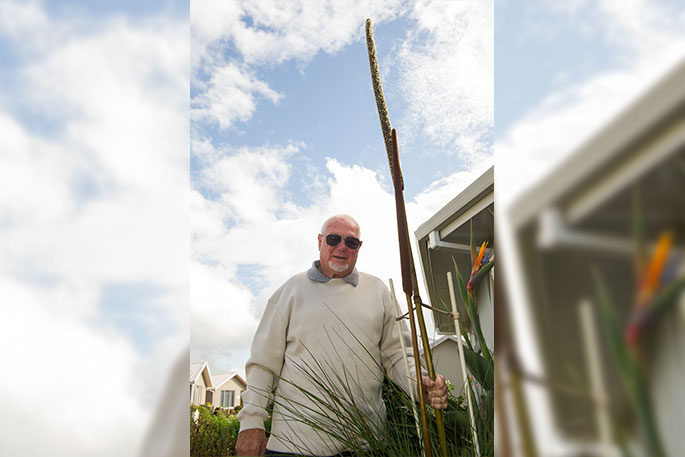
To the uninitiated, it's dead set ugly – a bit like the face only a mother could love.
But the Xanthorrheoa Quadrangulata is hugely sentimental to the man who owns it.
'But when I ask people what they think of it, they say ‘what do I think of what?'” says Graham Wilton-Jones at the Baywater Retirement Village.
Even today as Graham's Xanthorrhoea blooms for the first time in more than 20 years, it's certainly one of nature's wonders. The event is memorable but the bloom itself is underwhelming. 'No, it's not the most pretty of plants,” admits Graham.
Xanthorrhoea, a tussocky green bush with the blossom – a long straight spear, a yellow-brown velvety seed head – not unlike the bullrush or raupo. Most flowers when they bloom make a statement. But if you sent a dozen of these blooms it's unlikely you'd win a heart – unless you were wooing a botanist.
It's a plant native to South Australia and a genus of about 30 species. All grass trees are slow-growing and, as in Graham's experience, slow to bloom. A two-metre tall member of the fastest-growing Xanthorrhoea may be 100-200 years old and a more slow-growing species of equal height may be more than 400 years according to Ministry of Primary Industries senior scientist, Brian Quinn.
'Highly ornamental and widely cultivated as garden ornamentals around the world.”
Graham and his late wife Dianne, who shared an interest in exotics, bought two of the Xanthorrhoeas in Pyes Pa 20 years ago. 'Even then they cost me $75 each.” Not cheap.
When he walks past it now it has sentimental value. 'I think of her,” says Graham. 'It was something we shared.” And he's just sad she never got to see it blooming.
Xanthorrhoea is commonly called grass tree or grass gum tree. It was also inappropriately known as ‘black boy' because the trunked species purportedly resembled an Aborigine holding a spear. That's now considered offensive to indigenous Australians and is consigned to the past.
Xanthorrhoea also caused come anxiety when it showed up in New Zealand. The risk concern was the plants ‘weediness' – a characteristic which might enable it to form self-sustaining populations and be difficult to eradicate. It might have also interbred with related species and degraded natural habitats. But apparently our climate put paid to that notion. Xanthorrhoea is on the Plants Biosecurity Index and eligible for importation. However nursery stock need an import permit and require a period of quarantine.
'It may look like any other tussock grass,” says Graham. 'But you need the knowledge to understand and appreciate it.” And Graham, son of a Marton florist and nurseryman, has that knowledge.