
Throughout the month of October our country's national icon is celebrated during ‘Save the Kiwi Month' - a national campaign aimed at raising awareness of the plight of kiwi as well as funds to support work being done on the ground to save our treasured bird.
The campaign is led by Kiwis for Kiwi, an independent charity that supports community-led kiwi conservation projects nationally by raising and distributing funds.
People are encouraged to take action by making their patch predator free, volunteering at any nearby kiwi project, having dogs kiwi avoidance trained, buying a Kuwi the Kiwi product or by holding a great kiwi morning tea fundraiser.
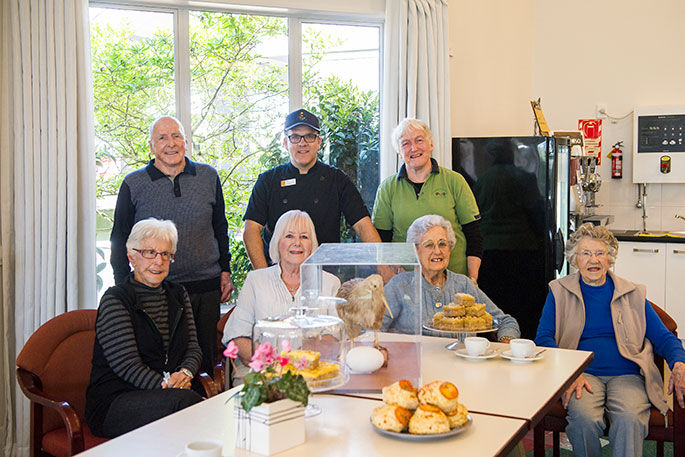
Carole Long, one of Otanewainuku Kiwi Trust's longest serving volunteers, is doing just that by hosting a morning tea for her own community in Bayswater Village which will help raise money for the cause.
'I've been here nearly six years and my husband was with me for three years,” says Carole. 'It's nice that I'm here and its home.
'I used to work for the Department of Conservation,” she says.
'In 1959 I also worked for Internal Affairs doing wildlife service work and my dad was in Lands and Survey, so this kind of work has always been a part of my life.”
Last week, which was Conservation Week, consisted of Carole attending many conservation events around town.
'The Otanewainuku Forest Trust has just finished putting out poison and bait stations, which means if rats get poisoned stoats will eat them.
'That also means all the other little birds up there, like the Kokako, will be free to nest because they are at risk from rats and possums.
'Stoats are too cunning - they won't eat anything except critters, so we have to trap them in tunnels and we do that all year.
'We targeted the rats and possums just before nesting, then you put tunnels with ink in the middle and they run through and you see how many rats are passing through.
'They got zero two nights in a row last week, and they tried it twice last week because they didn't believe it.”
On top of this they also carry out possum monitoring, says Carole.
'The biggest challenge for kiwi is that they have no cuttlebone, no flight bone or wish bone and they are really fragile.
'If a dog even so much as nudges them, or tries to pick them up, it cracks their ribs and they die.
'Dogs kill hundreds of kiwi and it's a real challenge to get people to keep their dogs away.
'Not even Kiwi Aversion training works as well. Dogs are fine while you're looking but it's when you look away - that's when they attack.”
Next up for Carole is her Great Kiwi Morning tea, which she is hosting for locals in her own retirement village.
Metlifecare Bay of Plenty social regional events co-ordinator Samantha Martin says the annual event is highly anticipated by those in the community.
'This is something that is run here every year,” says Samantha. 'Around 80 people in our village attend.
'In our community, Carole is one of the leaders in her field. She's worked in conservation, wildlife and for the environment for just about all her life and she's really passionate about it.
'We do bus trips here at Bayswater and two or three times a year she'll take people out and talk about flora, fauna and wildlife.
'We love raising money in this community. Another group of ladies here have just raised money for breast cancer charities, so it's something the residents and the staff are really passionate about.
'Bringing awareness about conservation topics to people's minds is really important, plus Carole is a really great speaker – people are really interested and entertained.”
Carole now encourages all locals to get involved by inviting friends, family or colleagues to their own Great Kiwi Morning tea event.
For more information on how to get involved, visit: www.kiwisforkiwi.org