
 |
Weather Eye with John Maunder |
The Southern Oscillation Index (SOI) is a standardized index based on the observed sea level pressure differences between Tahiti and Darwin, Australia.
The SOI is a leading measure of the large-scale fluctuations in air pressure occurring between the western and eastern tropical Pacific (i.e., the state of the Southern Oscillation) during El Niño and La Niña episodes.
In general, smoothed time series of the SOI correspond very well with changes in ocean temperatures across the eastern tropical Pacific.
The negative phase of the SOI represents below-normal air pressure at Tahiti and above-normal air pressure at Darwin.
The positive phase of the SOI represents above-normal air pressure at Tahiti and below-normal air pressure at Darwin.
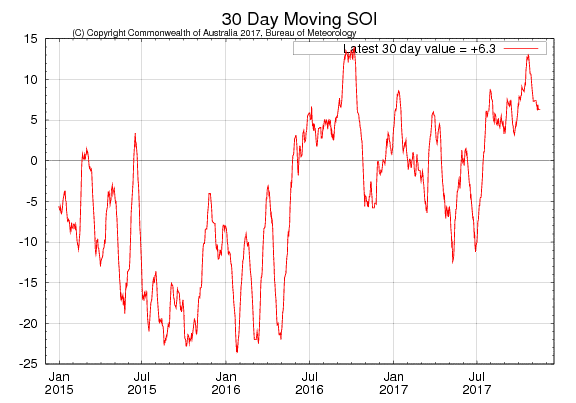
Prolonged periods of negative SOI values coincide with abnormally warm ocean waters across the eastern tropical Pacific typical of El Niño episodes.
In contrast, prolonged periods of positive SOI values coincide with abnormally cold ocean waters across the eastern tropical Pacific typical of La Niña episodes.
Sustained negative values of the SOI below −8 often indicate El Niño episodes.
The 2017–18 La Niña has ended. El Niño–Southern Oscillation (ENSO) indicators have eased back to neutral levels over the past several weeks. This means the ENSO Outlook has shifted from LA NIÑA to INACTIVE.
The end of the La Niña is clear in oceanic and atmospheric indices. Sea surface temperatures have warmed steadily since December, and are now in the neutral range. Waters beneath the surface have also warmed. In the atmosphere, cloudiness near the Date Line has returned to near-average levels, and trade winds are generally near average across the equatorial Pacific. Likewise, the Southern Oscillation Index (SOI) is well within the neutral range.
Most models indicate that ENSO-neutral is the most likely scenario through the southern hemisphere autumn and into winter
The 2017–18 La Niña has ended. El Niño–Southern Oscillation (ENSO) indicators have eased back to neutral levels over the past several weeks. This means the ENSO Outlook has shifted from LA NIÑA to INACTIVE.
The end of the La Niña is clear in oceanic and atmospheric indices. Sea surface temperatures have warmed steadily since December, and are now in the neutral range. Waters beneath the surface have also warmed. In the atmosphere, cloudiness near the Date Line has returned to near-average levels, and trade winds are generally near average across the equatorial Pacific. Likewise, the Southern Oscillation Index (SOI) is well within the neutral range.
Most models indicate that ENSO-neutral is the most likely scenario through the southern hemisphere autumn and into winter. The 30 day moving average of the SOI as calculated by the Australian Bureau of Meteorology as of March 11, 2018 is shown in the chart below.
El Nino and La Nina weather affects over New Zealand (source NIWA)
During El Niño, New Zealand tends to experience stronger or more frequent winds from the west in summer, typically leading to drought in east coast areas and more rain in the west.
In winter, the winds tend to be more from the south, bringing colder conditions to both the land and the surrounding ocean.
In spring and autumn south–westerly winds are more common.
La Niña events have different impacts on New Zealand's climate. More north–easterly winds are characteristic, which tend to bring moist, rainy conditions to the north–east of the North Island, and reduced rainfall to the south and south–west of the South Island.
Therefore, some areas, such as central Otago and South Canterbury, can experience drought in both El Niño and La Niña.
Warmer than normal temperatures typically occur over much of the country during La Niña, although there are regional and seasonal exceptions.
Although ENSO events have an important influence on New Zealand's climate, it accounts for less than 25 per cent of the year to year variance in seasonal rainfall and temperature at most New Zealand measurement sites.
For further information on a range of weather/climate matters see the following textbooks books (all available at specialised libraries)
"The Value of the Weather" (1970), "The Uncertainty Business - Risks and Opportunities in Weather and Climate" (1986), "The Human Impact of Climate Uncertainty - Weather Information, Economic Planning, and Business Management " (1989), all by W.J.Maunder