
 |
Weather Eye with John Maunder |
The Sun has an associated magnetic field known as the interplanetary magnetic field (IMF). When this interacts with the Earth's magnetic field some changes occur in the Earth's atmospheric circulation.
From time to time, as it sweeps past the Earth, the direction of the IMF changes from towards the Earth to away from the Earth. The time of this change varies but on average could be regarded as about once every 12 days.
In a study using data for the 21-year period 1997-2017 (published in the Meteorological Society of New Zealand Newsletter 156: Autumn 2019, Graham Ward mailto:gfaw@actrix.co.nz) has found what appear to be significant changes in the Southern Oscillation dex (SOI) at times when the IMF changes direction. These events are known as IMF sector boundary crossings. Data giving the time and direction of these crossings were obtained for this study from the Wilcox Solar Observatory (Svalbard Sector Boundary List 1926 – present).
The Wilcox Solar Observatory (WSO) began collecting daily observations of the Sun's global (or mean) magnetic field in May 1975, with the goal of understanding changes in the Sun and how those changes affect the Earth. That science is now called space weather. Since May 1976 daily low-resolution maps of the Sun's magnetic field have been made at the WSO, along with observations of solar surface motions. The observatory is located in the foothills just west of the Stanford University campus. Current research topics include space weather, the large-scale magnetic field, and the solar cycle.
The SOI is effectively a measure of the barometric pressure difference between Tahiti and Darwin and can be regarded as a key indicator of the overall state of the global climate at the time. The chart below from the Australian Bureau of Meteorology shows the values of the SOI from January 2017 to October 2019. .
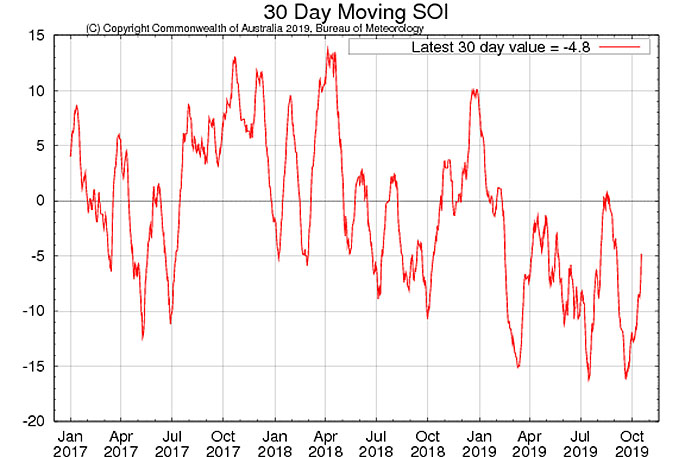
The changes in the SOI at the time of each IMF change of direction (sector boundary crossing) were found to be very large on the average during the two extreme El Nino years 1997 and 2015 (accompanied by very low negative values of the SOI), and also during the extreme La Nina years 2010 and 2011 (accompanied by very high positive values of the SOI). Values of the SOI were generally less (positive or negative) in the remaining years of the study and the apparent effect on the SOI at the time of each sector boundary crossing in those years generally smaller, but still noteworthy.
The revelation of these results leaves us with one big question:
'As it seems most unlikely that the results are due to pure chance, what exactly is the mechanism causing them?”
Are interplanetary/solar magnetic (tidal) forces responsible? Could these influences be largely or at least partly the cause of the global climate changes that we are now witnessing?
A paper by Italian scientists SA Capuano et al published in 2018 offers a further insight into this subject. The extract from the published paper includes the following:
The debated question on the possible relation between the Earth's magnetic field and climate has been usually focused on direct correlations between different time series representing both systems.
However, the physical mechanism able to potentially explain this connection is still an open issue. Finding hints about how this connection could work would suppose an important advance in the search of an adequate physical mechanism.
Here, we propose an innovative information-theoretic tool, i.e. the transfer entropy (which is the transfer of information between two random processes) as a good candidate for this scope because is able to determine, not simply the possible existence of a connection, but even the direction in which the link is produced.
We have applied this new methodology to two real time series, the South Atlantic Anomaly (SAA) area extent at the Earth's surface (representing the geomagnetic field system) and the Global Sea Level (GSL) rise (for the climate system) for the last 300 years, to measure the possible information flow and sense between them.
This connection was previously suggested considering only the long-term trend while now we study this possibility also in shorter scales. The new results seem to support this hypothesis, with more information transferred from the SAA to the GSL time series, with about 90% of confidence level.
This result provides new clues on the existence of a link between the geomagnetic field and the Earth's climate in the past and on the physical mechanism involved because, thanks to the application of the transfer entropy, we have determined that the sense of the connection seems to go from the system that produces geomagnetic field to the climate system.
Of course, the connection does not mean that the geomagnetic field is fully responsible for the climate changes, rather that it is an important driving component to the variations of the climate.
Sunspots Update
As of October 21, there have been 213 days in 2019 when the sun has had no sunspots. Data on spotless days are available from 1849 and the year 1913 with 311 spotless days is the highest spotless calendar year. The year 2019 with 213 spotless days is currently the 11th most spotless days year ( since 1849) .
For further information on a range of weather and climate and climate matters see: https://sites.google.com/site/climatediceandthebutterfly/
The physicist Leo Szilard once announced to his friend Hans Bethe that he was thinking of keeping a diary: 'I don't intend to publish, I am merely going to record the facts for the information of God.' 'Don't you think God knows the facts?' Bethe asked. 'Yes' said Szilard. "He knows the facts, but he does not know THIS version of the facts'
"(From Hans Christian von Baeyer, "Taming the Atom" (from the preface paragraph in "A Short History of Nearly Everything", by Bill Bryson, A Black Swan Book, 2004)