 |
Daniel Hutchinson From The Hutch |
Aaaah Christmas is nearly upon us, so it's nearly time to panic.
Usually I leave these thoughts until much later but consumerism caught me with a sneaky jab to the thorax.
This year, to get us all in the mood to spend lots of money we don't have on things we don't know people want, retailers have adopted a terrifying American tradition, with an equally frightening name.
BLACK FRIDAY!
Clearly I've been living under a rock because I had no idea what Black Friday was until last week. To be fair, it does sound like the anniversary of something terrible, rather than an invitation to go shopping.
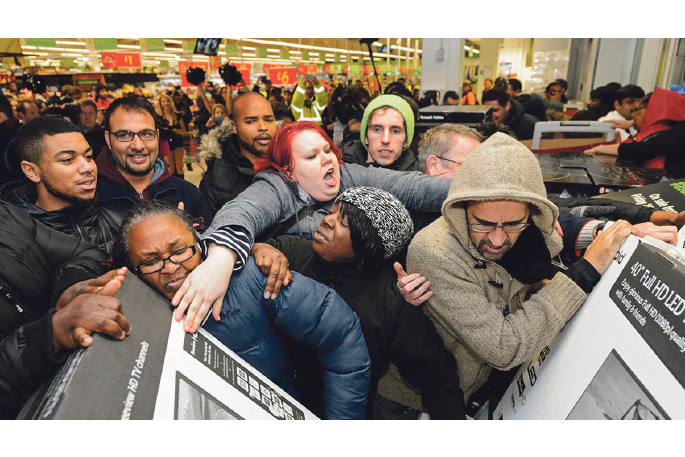
Turns out it's related to another US tradition, - also with no relevance to Kiwis – Thanksgiving. Black Friday is held the day after thanksgiving and has become the official start of the Christmas shopping season.
Kiwis call this ‘the silly season'.
Basically, retailers put stuff on sale for a day in the hope that people will line up and fight each other in the aisles for these once-in-a-lifetime deals. In The States there has been fisticuffs over everything from TV's to hair straighteners. The name Black Friday relates to 10 violent deaths. I don't like shopping which is why this event has never affected me.
But for someone who hates shopping, this is a far more sinister thing than Halloween. Instead of ghouls and goblins jumping out at you, there are steely-faced men and women armed with shopping trolleys, bearing down at speed. Babies are screaming in the aisles. A guy is trapped in the cosmetic section, flaring his nostrils and glaring like a wild, cornered boar.
It's all a bit unnerving.
Who'd have thought?
The Commerce Commission has just finished a year-long study into the fuel market and, would you believe, we are getting ripped off at the pump.
This is the exact wording from commission chair Anna Rawllings, just in case you find this too hard to believe.
'As a result of our study, we consider many fuel companies have been making persistently higher profits over the past decade than we would expect in a workably competitive market.”
To combat this, the commission recommends that petrol companies tell us how much petrol costs on big boards outside the station. Ummmm, are they like those big boards outside petrol stations that tell what the prices are?
The big boys will also have to sell to independent retailers at wholesale prices and publicly advertise the price. This allows more competition into the market.
At this point the heady fumes of big business overwhelmed me and I fell asleep.
Measles are no joke
There was startling news this week that a cartoonist had been offensive and insensitive for trying to get a cheap laugh out of the Samoan measles crisis.
The news wasn't so much that cartoonists are offensive but that he chose to pick on those who are suffering rather than those wielding all the power.
I initially assumed I had missed the back story and this one was meant to be satire aimed at self-indulgent Kiwis whose only interest in the unfolding tragedy in Samoa was how it affects their holidays.
However, it seems the cartoon wasn't that clever at all, everyone has apologised and now there are red faces and ‘employment issues' to deal with.
But we shouldn't be distracted that easily and just because we dodged the worst consequences of this outbreak here in New Zealand, our close friends and neighbours were not so lucky.
This disease spread quickly in New Zealand, months ago. We live in a country where vaccination rates have fallen over the years, providing fuel for the fire. But then it hit Samoa, which has one of the lowest rates of vaccination in the world. The result – a wildfire of disease and 60 people dead, so far.
Samoans have far more reason to be sceptical of the medical profession than Kiwis, particularly after a clinic botched a batch of MMR vaccines resulting in the death of two babies last year.
This provided plenty of credence to the anti-vax sentiment, with fatal consequences.
We don't want to meekly accept what we are told and that it is good for us but there seems to be something wrong when we are constantly waiting for disaster to happen before acting collectively.
You can put disaster preparedness, driving habits and multitude of other pending global and regional crises in the same boat.
We don't consider the consequences until it's too late and then we all take an interest.
daniel@thesun.co.nz