
 |
Weather Eye with John Maunder |
During the last few months I have been writing my fifth book.The idea for the book came about when I was visiting my family in Adelaide in January 2020 during a heat wave.
One day when the forecast was for 45°C my daughter Denise suggested I should stay inside, shelter from the heat and write another book.
I asked what did she have in mind and she simply said Climate the Truth.
My son Philip who has lived in Adelaide for about 30 years thought it was a good idea but after a few days thought I settled on a more appropriate title Fifteen shades of climate... the fall of the weather dice and the butterfly effect.
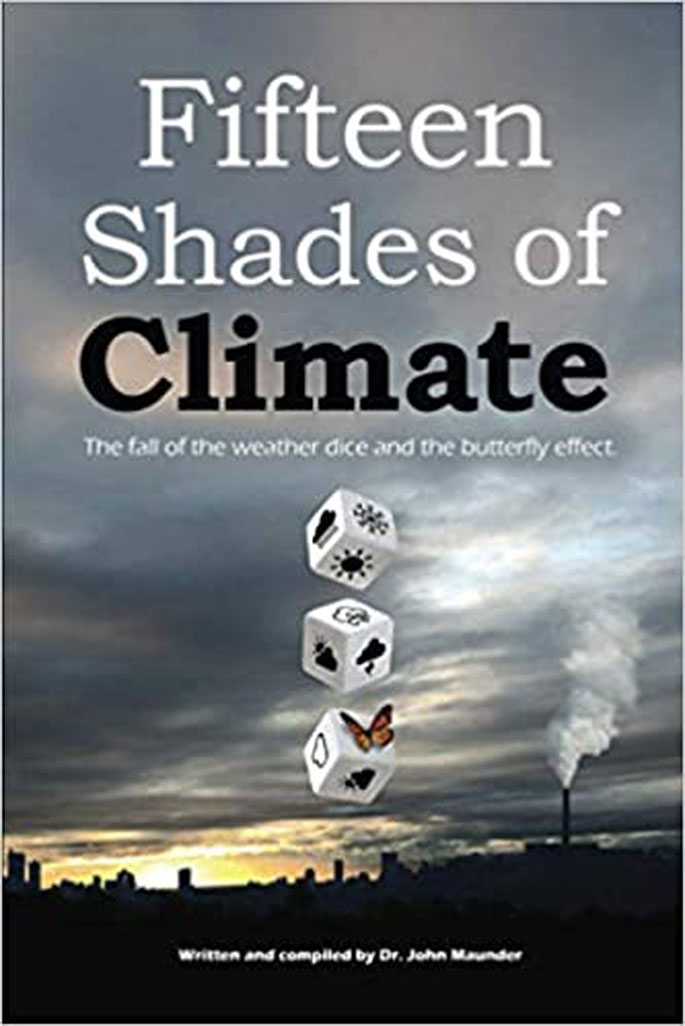
The book is now available through the web site amazon.com. and will be available in New Zealand in mid-December. Just Google 'fifteen shades of climate”
www.amazon.com/dp/B08NDR1GFD?ref_=pe_3052080_397514860
Fifteen shades of climate... the fall of the weather dice and the butterfly effect.
The Foreword, the Preface and a list of the Table of Contents are shown below.
From the cover of the book
The explosive nature of the subject climate change during the last three decades, and especially the last few years, when daily and sometimes hourly the words 'climate”, 'climate change” or 'global warming” are mentioned, is well recognised. It has brought about a significant challenge for those of us who are climate scientists to provide details of what is currently happening, why is it happening, and what is going to happen in the next month, year, and decade. An equal challenge is for media, including the social media, to present this information in a coherent manner, so that society, and political leaders at all levels - from the UN down to the local level - make appropriate decisions, whether this involves solar energy, the burning of coal, forest management, hydroelectricity, electric cars, veganism, nuclear power, the building of sea walls, moving to a better climate, learning to live with whatever Nature provides, or even who to vote for in the next election. The media and the education institutes are full (probably overfull) of the 'climate story”, but the information portrayed in many cases lacks a full appreciation of the complexity of the climate system. The aim of this book is to 'correct” this anomaly. Writing for the non-specialist as well as to the climate community, the book should appeal to graduate classes, not specifically associated with climate, such as history, architecture, political science etc., as well as undergraduate and graduate classes in climate and environmental science. The book should also be of interest to those outside academia such as the media, politicians and the informed public. The author, Dr John Maunder, was President of the Commission for Climatology of the World Meteorological Organization from 1989 to 1997, and has over the last 70 years been involved in the 'weather business” in various countries, including New Zealand, Australia, Canada, the USA, Ireland, Switzerland and England, through activities in national weather services, universities and international organizations. Publications include four books: The Value of the Weather (1970), The Uncertainty Business - Risks and Opportunities in Weather and Climate (1986), The Human Impact of Climate Uncertainty - Weather Information, Economic Planning, and Business Management (1989), and the Dictionary of Global Climate Change (1994). Dr Maunder is now retired, living in Tauranga, New Zealand.
The number fifteen in the title relates to the number of chapters in the book but it could more realistically relate to the fifteen or more facets of my eighty years in the 'weather business”. These years cover my schooling in New Zealand's Golden Bay and Nelson College, the University of Otago, employment in the New Zealand Meteorological Service, the University of Otago, the University of Victoria in Canada, the University of Missouri, the World Meteorological Organization, the University of Delaware, the 1985 WMO/ICSU/UNEP Villach Conference, the 1979 WMO First World Climate Conference, the 1990 Second World Climate Conference, the Stockholm Environment Institute, the University College Dublin, the weather business in New Zealand, writing several books, many scientific papers and a host of media releases.
FOREWORD by John Zillman AO FAA FTSE President (1995-2003) of the World Meteorological Organization
There are probably few people in the world who have originated and accumulated as much detailed knowledge of as many different shades of climate as John Maunder. He is a font of wisdom on climate matters and I believe he has served the world extremely well over the past 50 years through the way he has shared that knowledge and wisdom with the global community.
I first met Dr Maunder, when he was Chief of the Agricultural Branch of the World Meteorological Organization (WMO), at the May 1975 WMO Congress in Geneva, and again through his contribution to the proceedings of the December 1975 Monash (Melbourne) Conference on climate change and variability. The WMO Congress commissioned one of the first high-level international expert assessments of climate change and Dr Maunder's Monash Conference contribution was among the first on the international scene to preview the emerging political and economic dimensions of climate variability and change.
For the next 40 years, Dr Maunder was at the centre of the rapidly advancing international scene on climate data, research, applications and impact studies. This included academic appointments in New Zealand, Canada, the United States and Ireland. When the 1979 WMO Congress established the World Climate Programme (WCP) as an international interdisciplinary framework for understanding and managing climate variability and change, it assigned much of the responsibility for WCP implementation to the WMO Commission for Climatology of which John Maunder was a respected member and future leader.
Through the sixteen years of his Vice Presidency (1981-89) and Presidency (1989-96) of the WMO Commission for Climatology, Dr Maunder guided the international implementation of the ‘data' and ‘applications' components of the WCP. As a member of the WMO Executive Committee (now Council) through that period and President of WMO for Dr Maunder's final two years as President of the Commission, I saw the benefit of his wise and balanced advice to all WMO Member countries across the full range of climate matters. And, as Director of the Australian Bureau of Meteorology at the time, I was particularly pleased when he crossed the Tasman and joined the Bureau as a resident climate expert in 1990-92.
Dr Maunder has always been ahead of the game on climate matters. Before the costs and benefits of the impacts of weather became an issue, he had written a book on ‘The Value of the Weather'. Before the rest of the world had worked out how to use weather and climate information to manage the risks and opportunities of weather and climate variability and extremes, he had captured the essence of the problem with a book on ‘The Uncertainty Business.' And before the First Report of the Intergovernmental Panel on Climate Change (IPCC) and the 1990 Second World Climate Conference had set in train the negotiation of the United Nations Framework Convention on Climate Change (UNFCCC), he had produced a climate lexicon that became, for many years, the definitive international ‘Dictionary of Global Climate Change.'
While Dr Maunder comes from a meteorological generation for whom the study of climate embraced much more than concern with greenhouse warming and before the venerable scientific field of climatology had been repackaged and narrowed to ‘climate science', he also became deeply involved in the early study of human-induced climate change. His extensive background in traditional climatology and his participation in the 1985 Villach Conference on the climatic effects of increasing carbon dioxide made him a respected source of wise advice to WMO Member countries when concern with ‘greenhouse warming' burst upon the world in the 1980s. No-one can keep up with it all but I know of few traditional climatologists who have kept such a careful watch on all aspects of the growing global concern with climate change over the 35 years since Villach. This book is the result and the repository of the accumulated Maunder wisdom of those years.
Dr Maunder sees himself as a ‘realist' on human-induced climate change. He is troubled by the over-simplification of the climate story and sets out to foster a better public appreciation of the complexity of the climate system. But, while he goes to great lengths to present a wide range of perspectives, including many he disagrees with, he does not refrain from making clear his own views on greenhouse warming or on the many other contentious issues captured in the fifteen shades of climate covered in the fifteen chapters of this book. The issues covered, some quite succinctly but others in great detail, represent almost a complete climate lexicon in their own right and I would be surprised if any reader failed to find at least a few new and illuminating slants on some of the many fascinating different aspects of climate.
This is not a book for those looking for unambiguous scientific support for greenhouse action. But it is, in my view, among the best you could hope to find by way of highly readable and authoritative answers to many of the everyday puzzles of climate. And, for those who have come to the frontiers of climate science without a background in traditional climatology, it contains much distilled wisdom from a generation of progress in a field of study that was once described by the great mathematician John von Neumann, as the most difficult unsolved problem still to confront the scientific intellect of man(sic.
This book also provides a few sobering reminders that, despite the enormous progress of the past fifty years, the von Neumann characterisation may still be close to the mark. I have not always agreed with everything I have found in Dr Maunder's writing but I have always regarded his books as the epitome of scientific honesty and practical wisdom on climate issues. This book brings it all together. Read any or all of its chapters and you will be wiser on the many fascinating twists of the climate story.
John W Zillman AO FAA FTSE Former Director (1978-2003) of the Australian Bureau of Meteorology Former President (1995-2003) of the World Meteorological Organization
PREFACE
The explosive nature of the 'climate” has brought about a significant challenge for those of us who are climate scientists to provide details of what is currently happening, why is it happening, and what is going to happen in the next month, year, and decade. An equal challenge is for media, including the social media, to present this information in a coherent manner, so that society, and political leaders at all levels - from the UN down to the local level, make appropriate decisions, whether this involves solar energy, burning of coal, forest management, hydro electricity, electric cars, veganism, nuclear power, the building of sea walls, moving to a better climate, learning to live with whatever climate Nature provides, or even who to vote for in the next election.
There are many aspects of climate that could be written about, and this book includes most subjects that are commonly discussed in the media, which should be of interest to the public at large. As always there are continual developments in the climate scene and readers may wish to follow the current research by a simple Google search of any topic such as methane, sea level changes, winter temperatures in New Zealand, or an answer to such a question as 'Are hurricanes increasing or decreasing in frequency?” The information in this book aims to provide a 'need to know” background on weather and climate matters, climate change, and 'global warming” with the aim to promote a better understanding of these matters. In my 88 years I have been involved in a wide range of activities in the 'climate business”; from watching a river overflow into the small town of Takaka, Golden Bay, New Zealand when I was eight years old and asking why it happened, and was it good or bad; to the realms of several national meteorological services and universities, to the weather business, and the World Meteorological Organization.
Essentially, my book is a collection of specific activities and writings on the questions of climate, climate change, climate's variability (natural or otherwise) and climate politics over the years. In this regard I am reminded of the physicist Leo Szilard (1898-1964) who once announced to his friend Hans Bethe that he was thinking of keeping a diary: ‘I don't intend to publish, I am merely going to record the facts for the information of God.' ‘Don't you think God knows the facts?' Bethe asked. ‘Yes' said Szilard. ‘He knows the facts, but he does not know this version of the facts.'*
Dr. John Maunder
*From Hans Christian von Baeyer, author of 'Taming the Atom ”, (from the preface paragraph in 'A Short History of Nearly Everything”, by Bill Bryson, A Black Swan Book, 2004).
****
Some of the items in my book
Climate change 2020 and the Villach Conference of 1985
Climate overview: The last 400,000 years
The 'hockey stick” graph of global warming
Polar bears... increasing or decreasing?
Climate forecasts - how good are they?
Climate change projections for NZ to 2120
Solar activity and spotless days
The Maunder Butterfly
Solar magnetic variations and the Earth's climate
Gulf Stream - two viewpoints
Southern Annular Mode (SAM)
What are El Niño and La Niña?
Central England temperatures 1700-2018
Global annual temperatures
Arctic and Antarctic Sea Ice
Vikings and their explorations in a warmer world
Building the cathedrals of Europe... the climate factor
An Inconvenient Truth movie
Sea level changes
The year without a summer
Volcanic eruptions
Urban heat island effect
Australian forest fires and climate
Methane 265
Emission Trading Schemes (ETS)
Building sea walls to combat rising sea levels
Declaring Climate Emergencies
Climate refugees
Paying for carbon emissions relating to air travel
Geothermal energy
Nuclear Energy
Tidal Power
Biomass
Intergovernmental Panel on Climate Change (IPCC)
The Paris Climate Agreement
Climate change: three sides of the story
The Kyoto Protocol
Ozone and the 1987 Montreal Protocol
Right and left of climate policies
Green movements around the world and their climate agenda
NIWA's seven- and eleven-station series
Tauranga annual afternoon temperatures 1913-1919
Tauranga annual rainfalls 1898-2019
Climate extremes in New Zealand
In the bleak mid-winter
Meteorology and philately
Groundhog Day, February 2
**********************************
(please include this if there is sufficient space)
TABLE of CONTENTS
Acknowledgements Foreword Preface The fall of the weather dice and the butterfly effect
1 What controls the weather dice? 1 Climate change 2020 and the Villach Conference of 1985 3 Climate change: both sides of the story... a Rotary Conference discussion 5 Ten big climate questions answered 10 Key points about climate change 15 Climate overview: The last 400,000 years 16 Is there an ideal climate? 18
2 Methods of inferring/detecting changes in the climate 25 Recording the weather 27 Homogenization of climate observation and quality control 42 The 'hockey stick” graph of global warming 47 Glaciers 50 Ice cores 56 Tree rings 60 West Antarctic Ice Sheet 67 Polar bears... increasing or decreasing? 72
3 Forecasting the climate 75 Weather and Climate Forecasting 77 Blocking Highs 96 Climate forecasts - how good are they? 99 Climate change projections for NZ to 2120 106 Will it be wetter or drier? 111
4 The Sun 119 Solar activity and spotless days 121 The Maunder Minimum 123 The Maunder Butterfly 124 Sunspot numbers 1700 - present 125 Sunspot numbers 1950 - present
5 Astronomical causes of climate change 129 Milanković cycles 131 Solar magnetic variations and the Earth's climate 142
6 The role of the oceans 145 Global ocean currents as climate controllers 147 Gulf Stream - two viewpoints 154 Indian Ocean Dipole (IOD) 159 Southern Annular Mode (SAM) 163 North Atlantic Oscillation (NAO) 167 What are El Niño and La Niña? 171
7 The climate record over the centuries 175 Central England temperatures 1700-2018 177 Southern Oscillation Index (SOI) 180 Tropospheric temperatures 1979 to May 2020 183 Global temperatures 1996 - May 2020 185 Global annual temperatures 1880 - 2019 187 Arctic and Antarctic temperatures January 1979 to January 2020 190 Arctic and Antarctic Sea Ice 192
8 Lessons from history 195 Vikings and their explorations in a warmer world 197 Building the cathedrals of Europe... the climate factor 203 The Dust Bowl era in the United States in the 1930's 208 An Inconvenient Truth movie 214 Did global warming take a break? 218 Sea level changes 220
9 Extreme events 223 The year without a summer 225 Volcanic eruptions 228 Tropical Cyclones 232
10 Anthropogenic influences on the climate 243 The Greenhouse effect 245 Urban heat island effect 249 Australian forest fires and climate 255 Methane 265
11 Adaptation to climate 271 Emission Trading Schemes (ETS) 273 Building sea walls to combat rising sea levels 278 Declaring Climate Emergencies 287 Climate refugees 293 Paying for carbon emissions relating to air travel 299
12 Energy 305 Fossil fuels 307 Geothermal energy 311 Nuclear Energy 315 Solar energy 320 Wind power 326 Hydroelectricity 340 Tidal Power 344 Biomass 351 Nuclear fusion 360
13 Official viewpoints 367 Intergovernmental Panel on Climate Change (IPCC) 369 World Climate Programme 387 The Paris Climate Agreement 393 World Meteorological Organization 402 UN Climate Conference 2014 413
14 Political aspects 415 Politics and science 417 Climate change: three sides of the story 418 The Kyoto Protocol 420 Ozone and the 1987 Montreal Protocol 423 Right and left of climate policies 427 Green movements around the world and their climate agenda 432
15 The New Zealand climate over the last 150 years 439 NIWA's seven- and eleven-station series 441 Tauranga annual average afternoon temperatures 1914-2019 445 Tauranga Average Afternoon Temperatures April 1913-2020 447 Tauranga annual rainfall 1898-2019 449 Tauranga April Rainfalls 1898-2020 451 Climate extremes in New Zealand 453
Annex 455 In the bleak mid-winter 457 Meteorology and philately 459 Groundhog Day, February 2 461 The New Zealand Climate Science Coalition 463 The climate4you.com website 470 New Zealand Chief Scientist's report 474 Bibliography 476