
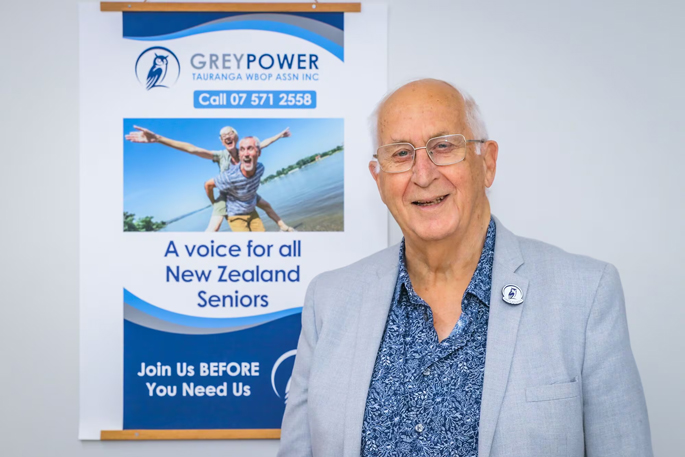
Katikati has been proposed to host a pilot programme aiming to help older homeowners downsize to smaller, accessible houses in their community.
Grey Power NZ Federation is supporting the proposal in response to what it has identified as a growing problem for Kiwis in their late 70s and 80s.
Katikati resident David Marshall, Grey Power New Zealand’s new national president, said many elder folk owned mortgage-free homes that were larger than they needed and increasingly difficult to maintain – but they could not access bridging finance to subdivide, build, or commission a smaller home in their community.
He said the issue became apparent in Katikati during the Covid-19 pandemic, when a community development group found more than 200 single people aged 80-plus were living in three- to four-bedroom houses.
“A survey done with about 90, which I was involved in, showed a significant number would like to downsize but they can’t because the banks won’t advance them the bridging finance – even if it makes financial sense.”
Costly, unsuitable
Living in large, older homes posed problems to ageing seniors because they were costly to heat, difficult to maintain, and increasingly unsuitable as people’s mobility levels changed, Marshall said. Like other Kiwis, they also faced rising costs of living, including rates and home maintenance.
Following the Katikati results, Marshall said Grey Power surveyed 2000 homeowning members nationwide.
About 40% wanted to downsize within the next five to 10 years, but only 5% expected that to be straightforward, Marshall said.
The rest had two significant barriers: Wanting to stay in their community but finding there was no suitable housing, and not being able to access finance because they received NZ Superannuation.
Marshall said those who sold their home first, to fund a new build or purchase of a smaller home locally, risked not finding anything affordable or suitable.
“This is what’s happening to people in Katikati. They sell and then there’s nothing there … then they’ve had to move to the Waikato to buy something with no social connections.”
Marshall said Grey Power had advocated on the issue to governments, but he did not see traction until he attended the Doors to Dignity campaign launch at Parliament in March. The nationwide campaign focused on the escalating crisis of homelessness and housing insecurity among older New Zealanders.
Marshall said he raised the issue with Community Housing Aotearoa chief executive Paul Gilberd.
“I said … what about this other group, where they don’t have accessible homes? They’re locking up rooms and not using them and the houses are not available for younger people who could occupy them.”
Practical solution
Gilberd connected him with a project manager prepared to help develop a practical solution and find funding.
Marshall said the result was the pilot project planned for Katikati, a rural town of about 5500 residents with close to 40% of the population aged above 60.
Five senior Katikati homeowners were being sought for the pilot, and Grey Power facilitated a public meeting this week to gauge interest.
The pilot would assist these homeowners to downsize to a safe, warm, home designed for ageing occupants and close to their existing social and support networks.
The first stage would identify seniors whose section could potentially be subdivided, and their new home built on the site.
If initial valuations and costings were approved, the subdivision project would be managed without requiring any upfront financial contribution from the homeowner.
Once completed, the retiree would move into a new, accessible two-bedroom, 70sq m dwelling and their prior home sold. Any cash surplus would be refunded once the sale was completed.
“The whole thing would be project-managed for them,” Marshall said. “That’s the ideal scenario – but not everyone can do that because their section doesn’t allow it.”
An alternative model would be having land where appropriate homes could be built in time for seniors to move into once their original home was sold, he said.
Beneficial to wider community
Marshall believed the pilot would benefit the wider Katikati community because the township had little residential land left to be developed.
“It could release these bigger homes that are under-utilised by their current older owners to larger and younger families. Plus all the services are there. It’s not as though you would be having to develop a greenfield site with no [utility] connections. This means utilising what we’ve got here and freeing up those places.”
Marshall said Katikati had younger residents on lower incomes who could not afford to buy a new home in a new subdivision.
“They need these older places that they can do up. So we see it as a win-win – that’s why we’re keen to sponsor this pilot project here.”
Possible rollout
If successful, Marshall said a community housing provider could roll out the model more widely across New Zealand.
Anyone interested in the pilot project could contact Grey Power Tauranga/WBOP branch on 07 571 2558 or email taurangagreypower@gmail.com.