
It's been called our 'competitive advantage” or 'blue gold”. By any name, freshwater is the basis of our agricultural production.
But it's under increasing pressure. Summer droughts, seasonal water shortages and competing demand for the resource mean efficient water-use is more important than ever.
DairyNZ, for its part, is assisting farmers to use water more efficiently and reduce water loss on farm. Data and information gained from a recent water-use study on 13 dairy farms around the Waikato can help with this.
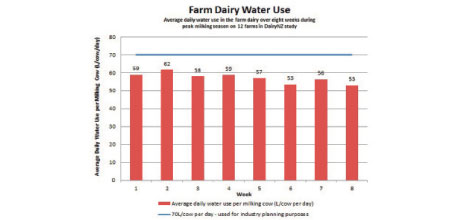
Daily water-use in the farm dairy was measured for eight weeks during the peak milking season. Nine of the 13 farms also monitored stock drinking water.
There was a good mix of farm dairy types, with nine herringbone sheds and four rotaries. Herd size ranged from 150 to 930. The study has provided some interesting early results.
Seventy litre per cow per day (l/cow/d) water-use in the dairy shed has long been used in the industry for planning purposes. (This number is derived from studies as far back as the 1980's and considered peak demand). We were keen to get a fix on water-use with today's farming practices relative to this 70 l/cow/d figure.
Meters
One purpose of the study was to learn more about correct meter installation and monitoring. The set-up at one farm appears to have led to some inaccuracies, so it has been excluded from preliminary results. First lesson: start with appropriate meter(s), properly installed.
Otherwise, just two of the 12 farms averaged more than 70 l/cow/d during the eight-week period. Three farms were in the 60-65 l/cow/d range, four were in the 55-59 l/cow/d range, and the other three had considerably lower rates.
There's a common belief that rotary systems use more water than herringbones. However, two farms in the study with rotaries were ranked second and seventh most efficient, in terms of water-use per cow.
A third rotary – same size as the two above – ranked 12th overall. With a modern set-up and fixtures it used
considerably more water. Lesson here:
For any system, get suppliers and installers to consider water-use efficiency in design, and install a system that enables you to meet efficiency goals.
Herd size
Herd size did not appear to be a determining factor either. The three farms with lowest water-use per cow had herds near the smallest, mid-range and second largest in the group. Lessons: shed set-up and day-to-day practices are crucial. Training and monitoring staff in their work pays off. One farm owner said: 'It's amazing how much less water we use when I do the yard wash down”.
Stock drinking water was very weather dependent (as you would expect), with water consumption ramping up during any run of hot, sunny days. The key, of course, is to ensure cows have all the water they need when they need it. This means careful attention to the farm water system.
One farm, milking 360 cows and averaging about 15m3 a day for stock water, spiked to 24m3 when an elbow on a water line, where it enters the trough, was sheared off by the cows. It was fixed, but blew off the next day taking the meter reading to 56m3 – a new daily record. The lesson (no surprises here): find leaks and fix ‘em fast and for good.
Twelve months
The study will continue with weekly meter readings to give us a 12-month record. It will be interesting to look at the effect of the drought on stock drinking water volumes.
DairyNZ intends to expand and build on this early work. Caleb Higham has recently joined the organisation as a graduate student. With support from DairyNZ, he will be pursuing a PhD in dairy farm water-use efficiency through Massey University.
In the meantime, farmers interested in tracking their own water-use should contact DairyNZ for a copy of the new resource ‘Smart Water Use in the Farm Dairy'. It includes a one-page worksheet to help estimate water-use (in the absence of metering). It's a great first step to getting a handle on how much water is being used on farm.
Gord Stewart is a specialist in water use and conservation. He is assisting DairyNZ with implementation of the Smart Water Use on Dairy Farms programme.