
 |
Weather Eye with John Maunder |
The "Maunder Minimum" is the name given to the period from 1650 to 1700 when the number of sunspots (solar storms) became almost zero.
The period is named after the solar astronomer Edward Walter Maunder (1851-1928) who while working at The Royal Observatory, Greenwich discovered the dearth of sunspots during the 1650-1700 period.
During one 30 year period within the Maunder Minimum there were only about 50 sunspots compared with a more typical 40,000. This period coincided with an extremely cold period in Europe.
Maunder was a driving force in the foundation of the British Astronomical Association, and was a Fellow of the Royal Astronomical Society.
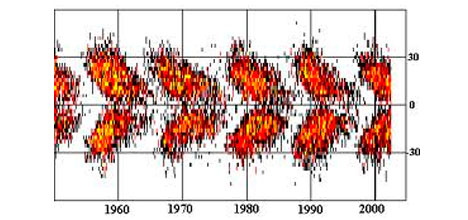
Throughout the solar cycle (of about 11 years) the latitude of sunspot occurrences varies with an interesting pattern. The chart shows the latitude of sunspot occurrence versus time (in years).
Sunspots are typically confined to an equatorial belt (on the sun) between 35 degrees south and 35 degrees north latitude. At the beginning of a new solar cycle, sunspots tend to form at high latitudes, but as the cycle reaches a maximum (that is, a large numbers of sunspots) the spots form at lower latitudes.
Near the minimum of the cycle, sunspots appear even closer to the equator, and as a new cycle starts again, sunspots again appear at high latitudes. This recurrent behaviour of sunspots gives rise to the 'butterfly'' pattern shown.
The reason for this sunspot migration pattern, understanding this pattern and how the Sun's internal magnetic field is generated, as well as the connection between solar activity and terrestrial climate is a continuing area of research.
Time will tell whether the sun will once again go into another Maunder Minimum within the lifetime of the present generation and what affect it will have on our climate.
The Maunder Butterfly diagram shows the position of sunspots since 1950 and shows that these sunspots first form at mid-latitudes and then widen and move towards the solar equator as each solar cycle progresses.
For further information see http://sites.google.com/site/climatediceandthebutterfly/