
 |
Mike Chapman NZKGI Chief Executive |
At last, we have a National Psa-V Pest Management Plan (Psa-V Plan) in place for the kiwifruit industry. It came into force on Friday, May 17, after being formally approved by the Ministry for Primary Industries.
This means the kiwifruit industry can now effectively deal with the disease Psa-V. The plan puts in place effective management of Psa-V across the large number and variety of organisations in the industry. It is backed up by enforcement provisions, so if voluntary compliance is not achieved, this is not the end of the matter. It provides for a consistent and coordinated approach at national, regional and grower levels. Without this, the effects of Psa-V would prove extremely difficult, if not impossible, to manage and control.
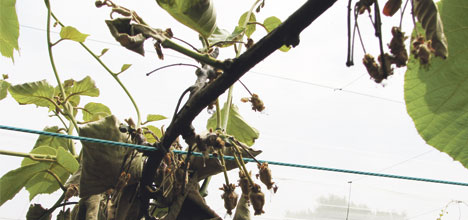
In order to manage the spread and impacts of Psa-V, there are now rules governing disease management, monitoring, movement and the development of plans. Achieving compliance through voluntary means will remain the primary focus when implementing this plan. However, the ability to enforce requirements in significant situations of non-compliance will ensure the most effective management of the disease.
The plan's objectives will be achieved by the kiwifruit industry as follows:
• Carrying out vine monitoring.
• Reducing inoculum, by cleaning up diseased and abandoned orchards, and wild kiwifruit populations.
• Controlling the movement of risk items, including kiwifruit plant material, and orchard equipment so that it does not spread Psa-V from orchard to orchard and from region to region.
• Applying best-practice orchard management, by implementing Psa-V research and development, on-orchard experience and grower innovation.
• Establishing preparedness and response systems, so if Psa-V is detected – in an area without Psa-V – immediate action can be taken to further limit the spread of Psa-V.
The plan establishes three different regions with different responses to Psa-V: exclusion, containment and recovery regions. In exclusion regions, the focus is on keeping Psa-V out and being prepared, should it arrive. In a containment region, the focus is on containing the disease as far as possible, to protect orchards in that region that have not yet detected Psa-V. Recovery regions are where Psa-V infection is wide spread such as in Te Puke. The focus in these regions is on effective orchard and vine disease management, including an effective spray programme, to reduce Psa-V inoculum in the region.
An important focus of the Psa-V plan is dealing with unmanaged and abandoned orchards. Until the Psa-V plan came into force, unmanaged and abandoned orchards had to be dealt with on a voluntary basis.
This meant that there was no way in which to deal with an unmanaged or abandoned orchard unless the landowner agreed to action what was required.
The question then became: who pays for removal of the orchard, if for example, it was abandoned? In many cases, the industry paid for the removal. Under the Psa-V plan, the first step will be to seek voluntary compliance.
However, if that is not forthcoming, then Kiwifruit Vine Health Incorporated can remove the orchard and seek reimbursement from the landowner.
The reason why it is so important to deal with unmanaged and abandoned orchards is because they are a continuing source of infection. To keep inoculum levels low, Psa-V infected vines need to be removed and protectant sprays needs to be applied. If infection is not managed, then Psa-V inoculum levels will rapidly increase and infect neighbouring orchards and eventually the entire district.
For the industry to get on top of Psa-V, it is vital for abandoned and unmanaged orchards to be effectively and quickly dealt with.
This is one of the main advantages of the Psa-V plan. If you have any concerns about what appears to be an unmanaged or abandoned orchard, contact KVH on 0800 665 825.