
 |
Mike Chapman NZKGI Chief Executive |
To succeed in any overseas market you need to know your consumer.
The Japanese market is one of the highest returning markets for many types of produce including fish, fruit and vegetables from New Zealand – and recently I had the chance to see it first-hand.
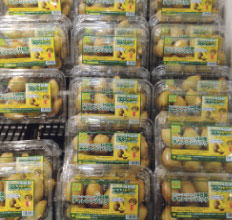 In Japan, best quality produce earns top dollar. New Zealand's kiwifruit can sell for about 98 Yen per piece of fruit, which is about NZ$1.20. The fruit earning this price is good quality and has high taste. The larger the fruit, the higher the price. We also saw jumbo, very large green Hayward fruit selling for 316 Yen each—which is about NZ$3.90. However, this was in a very high-end supermarket.
The Japanese market is also a very strong organic market. While in Tokyo, we witnessed a very orderly, but very noisy, anti-nuclear protest complete with those traditional Western protest songs. Our estimate is that about 3000 people were in the protest march. It got very little media coverage, but what it was all about was a total rejection of nuclear weapons and nuclear electricity generation. With both nuclear weapons and nuclear electricity generation, the people of Japan are well-qualified to speak out. We commented one day that Tokyo was very clean and pollution-free, only to be told except from the nuclear radioactivity that you can't see or feel.
Organic
The Japanese consumer is more inclined to purchase and pay for organic produce. They not only want quality, but safe produce. Organics is seen by many Japanese consumers as meeting those requirements and they will pay top dollar to get the high-quality and safe option.
The other notable consumer trend in Japan is that Japanese consumers tend to buy their fruit and vegetables daily, or every couple of days. They do not buy a lot of anything at one time.
They are more likely to buy one or two pieces of kiwifruit three or four times a week. A lot of these purchases are made at small local stores or Japanese-owned supermarkets, where there is very high focus on quality.
To date, the international supermarkets have not been successful in Japan due to their focus being on consumers buying weekly, in larger quantities, rather than daily. Critically, the international supermarkets have focused on cheap prices – and not the exceptionally high-quality stock demanded by the Japanese consumer. Walmart is apparently now having some success in the Japanese market by changing its focus to more frequent purchase and a quality offering.
A good illustration of Japanese consumers buying one or two pieces of fruit, or other produce, is the number of vending machines that are to be found on street corners, in parking lots – in fact anywhere. In my opinion, in New Zealand, these vending machines would potentially be targeted and their contents stolen. In Japan, these machines sit outside and are unguarded. But what they do is service the Japanese consumer by allowing them to buy one or two items. These machines do not just have drinks in them. You can buy heated meals, snacks, alcohol and even bananas one by one from vending machines.
Lots of small purchases of quality produce have implications for Zespri's supply chain. In Europe, Zespri can deliver truck-loads of fruit. In Japan, Zespri kiwifruit is delivered in small shipments and often part-pallets.
Trucks leaving a coolstore will often make many deliveries to many outlets, supplying a whole variety of fruit and vegetables. Planning the truck load and deliveries can take many hours, adding significant cost to the supply chain.
Marketing
To recover that cost from consumers, Zespri runs a very successful and sophisticated marketing programme across Japan. Zespri secures prime locations and large areas of shelf space in prime supermarkets. We saw a Zespri display, which in its entirety, measures four metres long and is located at the very start of the fruit and vegetable section of a high-end supermarket in Tokyo.
Fruit was being sold by the piece and in pre-packs, with some pre-packs having a mixture of green and gold kiwifruit. There were also pre-packs of 10 pieces of fruit, as part of a kiwifruit eating challenge.
The challenge that all exporters of produce to Japan, and other countries face, is to provide what the consumer wants, as that is what they will pay top dollar for. The example given of the failure of the international supermarkets to successfully penetrate the Japanese market clearly illustrates this.
Our continued success in Japan relies on Zespri, our exporter, continuing to meet the demands of the consumer.
The views expressed in this article are those of the author. The trip to Japan was fully-funded by the author.