
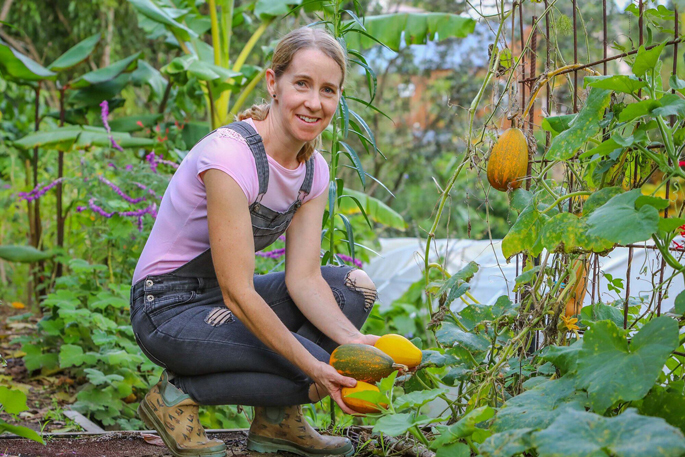
Tucked away in Welcome Bay is a food forest that feeds not just the belly, but a feeling of happiness and hope for the future.
One acre of land is flourishing at the hands of Selena Hardman.
Her self-sown Tauranga Food Forest has more than 370 fruit trees, all growing in symbiosis with a mix of perennials, herbs, flowers and more.
Being led around this remarkable sanctuary that Hardman has been working on for the past four years with partner, Rowen de Vries, you truly get transported.
As we weaved our way through banana palms, overhanging tamarillos, sprawling pineapple sage and fragrant blooms, it felt like we could have been on a tropical island.
Skinks skittered at our feet, the chickens cooed contentedly and patchouli perfumed the air.
“This morning I was walking along the top [of the forest] …the light was coming in, and I could just see a bit of mist coming up in the sunlight with the monarchs,” Hardman said.
“At times like that I just think, ‘How could you not want to share this? How could you create this and then not want people to come in and experience it too’, because it makes people so happy. We need more happiness in the world.”
Rare fruits
The happiness Hardman finds in her food forest is amplified by her love of growing rare and unique fruits of vibrant colours and tastes.
“I’ve got heaps of dragon fruit. Eventually, I’ll have 10 really rare varieties that I got from someone up north…They’re the thing I love growing the most because it really surprises people that we can grow them here. They’re so fresh, colourful and delicious.”

Among banana palms, pineapple sage and monarch butterflies, Selena Hardman’s Welcome Bay food forest is a slice of tropical magic in Tauranga. Photo / Kelly O'Hara
Another unique plant that Hardman is carefully tending to is the black sapote – aka the chocolate pudding fruit. The fruit of this plant has a custardy texture and a mild cocoa, vanilla, caramel flavour. “I cannot wait to try that for the first time!”
“The climate is just really good for growing things, and that’s why I am quite keen to experiment beyond what the standard is because I want to test the limit to see what we can grow here.”
Give it a grow
Hardman said she comes from a background of green fingers in Palmerston North; both her grandparents and parents were keen gardeners. Yet, much of her skill for growing is self-taught and fuelled by her enthusiasm to give things a go.
“It’s literally all from just watching YouTube videos,” she said.
“Even if I did a course, they’re not really going to cover how to grow four different types of pineapples or bananas. It’s from getting stuck in and experimenting. A lot of it comes from trial and error and seeing what you can do in your own climate.”
Hardman said she had learnt a lot about what temperatures plants can thrive in, having lost a couple of plants such as soursops to winter temperatures.
“Now I’ll learn it’s going to go in the tropical garden in the tunnel house, or in the greenhouse permanently, or I’m going to wait a bit longer until it’s bigger, and then I’m going to be very selective about where I plant it…there’s a lot more learning and thoughtfulness that goes into it.”
Seeing the forest grow has been a “real team effort” with her partner too. “[Rowen’s] done a really good job. He does the more structural stuff like the stairs and pathways. Without him doing that it wouldn’t be the same.”
Feed a feeling
The food forest is so much more than a fruit and vege garden on steroids, Hardman said. Working three days a week as a radiation therapist and having done so for the past 20 years, the food forest is her perfect place to slow down.
“It’s not just functional to feed you. It’s about how you feel being out there. Do you want to be out there? Are you loving it? Are you looking at all the flowers and the wildlife that the flowers bring in?…If you’re getting more bees and butterflies, you’re getting more pollinators to pollinate your flowers, so it all works together,” she said.
“It’s giving you so much to look forward to for the future…like seeing the first flower of something that you’ve been waiting for or experiencing the first fruit...there’s just so much good that comes out of it on so many different levels.”

A hidden oasis in Welcome Bay, Selena Hardman’s food forest blends rare fruits, rich biodiversity and a passion for growing something meaningful. Photo / Kelly O'Hara
Hardman also enjoyed reducing waste by growing her own food.
“With our perennial plants like the spinach…you don’t have to go and get lettuce in a plastic bag from the supermarket. Between us we’ve got four kids and I like to show [them] that you can grow your own, and let them experiment, trying all different types of food and expose them to different types of nutrition, and give them the confidence to try different things.”
This spring, Hardman will take small tour groups around her food forest to give people the opportunity to experience it for themselves.
For more information and to get connected to the food forest community, visit: https://taurangafoodforest.com/ or search “Food Forests Tauranga” on Facebook.