
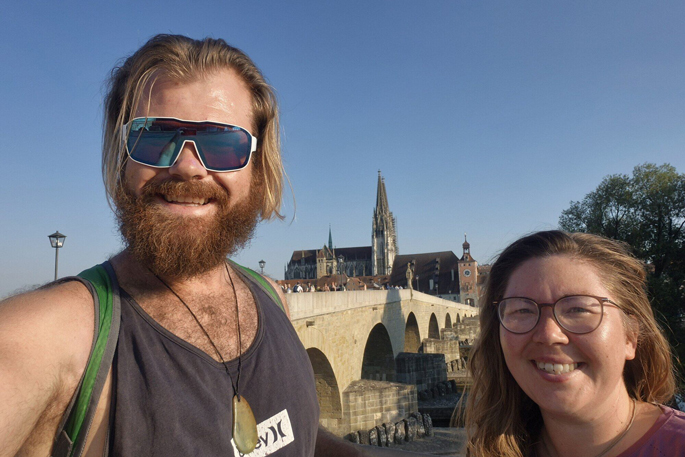
Bay of Plenty conservationists cycling the length of the Danube have found themselves riding through wildfires and alongside a river so low that World War II shipwrecks, bombs and other long-hidden relics are emerging from the riverbed.
When Anna Wentsch and Callum Armstrong set out from Germany on June 18, their mission was to cycle almost 3000km along the Danube, meeting conservationists, scientists and communities and finding out what New Zealand could learn from conservation efforts along one of Europe’s great rivers.
Seven countries later, the founders of Bay of Plenty-based Conservation Amplified had discovered a much bigger story.

Anna Wentsch and Callum Armstrong cycling in Bulgaria. Photo / Callum Armstrong & Anna Wentsch /Conservation Amplified
Speaking to The Weekend Sun from Bulgaria on Sunday, Wentsch and Armstrong described a landscape being transformed by extreme heat, drought and fire.
“Climate is a bigger part of the story now than we initially planned because of everything we’re seeing,” Armstrong said.
The couple have encountered several wildfires. In Serbia, they were cycling when smoke suddenly began gathering around them.

This photo shows a wildfire burning trees in Viotia region, west of Athens, on August 2, 2026. Greece faced multiple fronts and a growing damage toll after a week of wildfires devastated over 12,000 hectares of forest and agricultural land, experts said. (Photo by Aris Oikonomou / AFP) Photo / AFP
At first, they wondered whether it was a controlled burn, but as the smoke grew they realised it was a wildfire.
They tried calling emergency services, only to encounter border bureaucracy and language difficulties. By the time they reached a nearby village for help, the fire had grown dramatically.
“The smoke was coming up in black plumes of smoke, and it was right at the edge of the village,” Wentsch said.

Callum Armstrong escaping the wildfire in Serbia. Photo / Callum Armstrong & Anna Wentsch /Conservation Amplified
The locals, however, appeared remarkably accustomed to the threat. “They were just like, ‘Oh, it’s fine,’” Armstrong recalled.
The villagers told them fires were common and that authorities would intervene only if the situation became serious.
The couple were offered coffee, food from local gardens and cheese from a nearby factory before continuing their journey.
Since then, they had encountered at least two more fires, including one that started about 50 metres ahead of them while they were stopped repairing punctures.

While avoiding wildfires, a local family invited the couple in and shared coffee, garden produce and cheese. Photo / Callum Armstrong & Anna Wentsch /Conservation Amplified
Checking the weather and fire situation had become part of their daily routine.
“When you’re at a higher altitude, you’re looking out, and if you see some smoke coming up, you’re like, ‘Is that a farmer driving his tractor on a dirt road, or is that a fire?’” Wentsch said.
“It’s really in your mind.”
The fires are only part of what had shocked them. The Danube River itself had become dramatically shallower, with the exceptionally low water levels across parts of central and southeastern Europe disrupting shipping, agriculture and energy production.

Camping in Germany. Photo / Callum Armstrong & Anna Wentsch /Conservation Amplified
International news coverage in recent days highlighted one extraordinary consequence: as the river retreated, WWII-era German warships and other military relics were emerging from the water.
Near the Serbian-Romanian border, sunken German vessels deliberately scuttled in 1944 became exposed, some still containing dangerous ammunition. Elsewhere, bombs and other wartime objects had appeared from the newly-exposed riverbed.
But the spectacle of history emerging from the mud was less important to the cyclists than the modern consequences.
They’d seen cargo ships unable to move, ferries affected and crops struggling in the heat and dryness.

Callum Armstrong and Anna Wentsch in Hungary. Photo / Callum Armstrong & Anna Wentsch /Conservation Amplified
In Romania, the crisis had become an energy problem too. One reactor at the Cernavodă nuclear power plant was shut down because of low Danube water levels, with authorities taking extraordinary measures to maintain water flow to the remaining reactor.
Wentsch said the experience had changed the way they think about climate change.
“Are we seeing an isolated event or a preview of the future?” had become a question they repeatedly ask themselves. “I think it’s likely that it’s a preview of the future,” she said.

The Danube River which runs through Bulgaria has been drying up. Photo / Callum Armstrong & Anna Wentsch /Conservation Amplified
Armstrong said the biggest lesson had been how quickly environmental problems became human problems.
“When fires start coming to the edge of towns, when your freight ships can’t actually move through the river, when your crops are wilting, when you’re struggling to get electricity generation, then all of a sudden the problems with nature directly affect our economy, our livelihoods and our ability to live our lives.”
The pair believed that connection is particularly relevant to New Zealand.
Environmental decline could seem distant when presented simply as a problem for nature, but cycling through affected communities had shown them how closely rivers, agriculture, transport, electricity, jobs and everyday life were connected.
“Rivers are more than just a blue line on a map,” Wentsch said. “They’re so much more than just a navigational route.”
Cycling the European countries had also given the pair a slower and more intimate view of the continent than conventional travel.

Cycling has taken the pair away from major highways, and through rural villages, abandoned settlements and farmland. Photo / Callum Armstrong & Anna Wentsch /Conservation Amplified
Away from major highways, they’d travelled through rural villages, abandoned settlements and farmland, stopping for turtles crossing roads, picking wild plums and meeting fishermen and other locals along the river.
They’d also seen storks, Dalmatian pelicans, cormorants, lizards, geckos and golden jackals.
When they reach the Danube Delta, they will spend three days with conservation organisation Rewilding Romania before beginning their journey home.

Low water levels on the Danube River showing sand which is normally underwater. Photo / Callum Armstrong & Anna Wentsch /Conservation Amplified
They expect to be back in the Bay of Plenty about September 10.
While their original mission was to return with ideas for conservation in the Bay, they now expect to return with something more urgent: first-hand stories about what happens when an extraordinary river runs dangerously short of water.
To follow Conservation Amplified updates as Armstrong and Wentsch continue their cycle of the Danube, visit: conservationamplified.org