
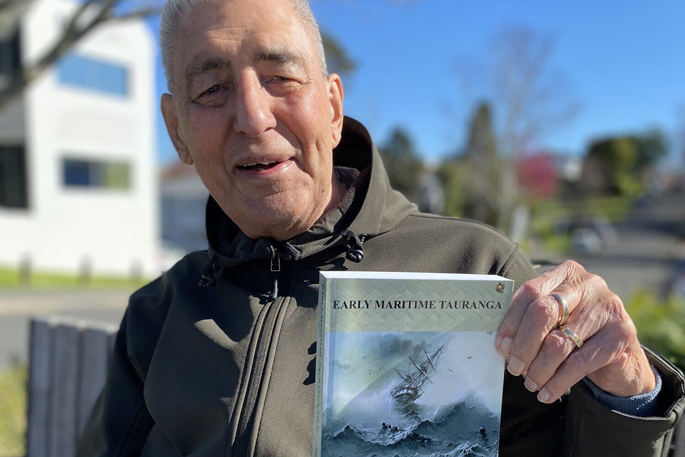
Shipwrecks hidden beneath the sands of Matakana Island, immigrant sailing ships battling fierce harbour currents and the remarkable resilience of Māori traders after the 1864 invasion of Tauranga are among stories uncovered in Pāpāmoa historian Dr Trevor Bentley’s latest book.
Released two years after Early Maritime Tauranga, Volume One, Bentley’s Early Maritime Tauranga: A History of Vessels, Visitors, Residents and Events, Volume II, 1864-1900s is his 11th published history book and continues the story of Tauranga Harbour from 1864 to 1900.
The 486-page volume – about 100 pages longer than the first – is richly illustrated with more than 170 historic photographs, paintings and sketches, spread across eight sections and 58 chapters.
Between the two volumes, Bentley published his 10th book Te Kaewa – The Wanderers: Māori Sailors on Euro-American Whalers, 1790s-1890s in January 2026.

Racing from Tauranga to Auckland with cargoes of perishable goods, the Tauranga-owned schooners Hope and Fortune arrived within a few hours of each other on February 2, 1866. The Orange Schooner by Montague Dawson (British, 1890-1973). Oil on canvas. 50.8 x 76.2cm. L.G.G. Ramsey, Montague Dawson, R.S.M.A., F.R.S.A., second edition, Leigh-on-Sea, 1970, p.43, no. 179, plate 39.
Although publishing three substantial books within two years seems a formidable task, Bentley said the process was simply the result of always having more than one project on the go.
“While I was researching and writing Volume One, I was collecting quite a bit of material for Volume Two,” he said. “So, it came together quite easily.”
The book begins at a pivotal moment in Tauranga’s history. Following the British military invasion in 1864 and the blockade of Tauranga Harbour, the thriving Māori trading fleet that had carried produce to Auckland throughout the 1840s and 1850s was effectively ended.
“The land-based economy continued, but the ships had to be abandoned to rot on the beaches or in the backwaters of the harbour,” Bentley said.
Very entreprenurial
Yet the story is not one of decline. Instead, Bentley found repeated examples of Māori adapting to changing circumstances. With more than 1000 British troops stationed in the district in 1864 and several hundred thereafter, local communities redirected their efforts towards supplying fresh vegetables, fruit, honey, fish and cured meats to the military. By the 1870s, many had returned to building vessels for the coastal trade. “They were always very entrepreneurial,” he said.
One of the book’s most intriguing sections explores Tauranga’s reputation as a challenging harbour for sailors.
Long before GPS, modern charts and powerful engines, captains relied on landmarks, tides and experience to navigate the narrow entrance. Strong currents sweeping around Mauao and constantly shifting sandbars claimed dozens of vessels, Bentley said.

The front cover of Early Maritime Tauranga: A History of Vessels, Visitors, Residents and Events, Volume II, 1864-1900s, by Dr Trevor Bentley. Photo / Supplied
He described the shoreline along Matakana Island as a historical “wrecking zone”, where schooners, cutters and steamers regularly ended their voyages.
“What was interesting was that after two or three years the sand swallowed them completely,” he said. “They’re still there, a very rich site for archaeologists, I think.”
The Lady Jocelyn
Among the dramatic stories was the arrival of the Lady Jocelyn, a 2000-tonne immigrant sailing ship carrying settlers for Te Puke on New Year’s Day, 1881. Despite carrying full sail, the powerful tidal currents repeatedly forced the ship backwards before local steamers finally towed it safely to its anchorage, Bentley said. “At the time, it was the largest vessel ever to visit New Zealand,” he said.
The book also recounts lesser-known local tragedies, including the loss of the cutter Oi, whose crew disappeared after the vessel was wrecked on Matakana Island. Search parties crossed the harbour in rough conditions, borrowed horses from local Māori and combed the length of the beach, recovering only a few personal belongings.
Bentley said much of his research came from digitised newspapers, the Alexander Turnbull Library, Auckland Libraries’ George Grey Collection and Tauranga’s own research collections.

The beach at Tauranga 26 April 1864 by E.A.Williams. 75/96 Hocken Pictorial Collections, Hocken Library, University of Otago, Dunedin.
One mystery remains unsolved, he said.
“I’ve yet to come across a detailed account by a Tauranga captain describing a single voyage,” he said. “Other researchers may yet find one.”
Even before Early Maritime Tauranga, Volume Two reached readers, Bentley had already turned his attention to his next project.
His 12th book, Ngā Heremana Wāhine - Māori Women Seafarers on Euro-American Ships, 1790s–1890s, would explore the little-known stories of Māori women who travelled aboard whaling ships, merchant vessels and Royal Navy ships throughout the Pacific.
Second nature
For Bentley, researching one book while writing another had become second nature. For Tauranga readers, Bentley’s research would mean more forgotten chapters of the city’s past continue to surface – sometimes from dusty archives, and sometimes, quite literally, from beneath the sand.
Win with The Sun
The Weekend Sun has one copy of Trevor Bentley’s new book Early Maritime Tauranga: A History of Vessels, Visitors, Residents and Events, Volume II, 1864-1900s to give away to one reader who can tell us which island in Tauranga Moana was the site of the most shipwrecks?
To enter, visit: www.sunlive.co.nz and click on the ‘competitions’ tab. Entries must be in by Tuesday, August 18.