
This month, five Tauranga-Western Bay community centres are running an awareness and fundraising campaign to future-proof their existence. It will shine a light on centres at Merivale, Welcome Bay, Gate Pā, Katikati and Te Puke. This week Merle Cave visits Merivale Community Centre.
It’s 10am on Monday and you can’t get a carpark near Merivale Community Centre. Three dogs are tied to the stair railing, mobility scooters are positioned at all angles, and an adjacent laundry room is humming.
Enter the building and seats are full of people waiting for the afternoon’s distribution of free food.
Kaumātua “Poppa Bill” Wilson is chatting to everyone, keeping minds busy and the atmosphere warm.
In the community kitchen, a group from Pearanui Trust cook vegetable soup for visitors and make cheesecakes for their Manaakitanga Through Food Programme – a 10-week hospitality and wellbeing course.
In the hall, Rowan Dawson takes people with disabilities through his Circability course.

Gate Pa residents Blache Beg and daughter Debbie try a Circability workshop at the centre. Photo / Merle Cave
Like a hive for bees, Merivale’s community centre is buzzing with activity for residents – of all ages, stages, backgrounds, cultures and nationalities.
“We do all sorts. It’s very much driven by people who come through the door,” centre manager Jennifer Murray said.
“We’re reacting to the need in the community, so we host a number of organisations on-site because we have a trusted relationship with our community.
“We also run a variety of programmes – again, partnering with organisations and community members.”
On Mondays, the centre hosts Huria Trust Clinic’s free nurse consultations. Bay Financial Mentors drop in 1pm-3pm. Thanks to Good Neighbour, kai is distributed to whānau in need from 2.30pm. Zumba classes run at night.
Tuesdays offer a Manaaki parents’ group. Wednesdays host strength and balance classes for older adults, counselling sessions, a Men’s Circle support group, and a night dance fitness class.
On Thursdays, Bay Financial Mentors are back, plus counselling sessions, a walking group, a tenancy relationship manager, ACC physio by koha (donation), and homework help for Years 9-13.
Fridays are for Workbridge, an employment drop-in service, counselling, and an afternoon HBU Mobile Health Waka.

Susanna Talbot and Kaarina Kotanen showing the no-bake cheesecakes their group made. Photo / Merle Cave
A free after-school programme runs Monday to Friday, and a rangatahi (youth) hub opens on Friday nights.
On top of this is a range of extra offerings, such as a monthly Hapori Kai Community Meal, when anyone can attend the centre for a free dinner.
“We have three student counsellors each working one day a week, a full-time social worker and a youth worker,” Murray said.
Free food was in big demand, she said. In addition to Mondays’ kai distributions, community members voluntarily cook meals on-site so there is food in the freezer at any time.
The free laundry is open 9am-5pm on weekdays. Bathrooms for showers are open the same times, and staff swipe people in.
Murray said no one judged anyone at the centre. “We don’t discriminate. We treat everybody the same, and we try to find out what they’re here for and link them up with the appropriate staff or service.
“Kaumātua Poppa Bill is a regular feature, so we know that he’s always there to welcome people.”
Asked why community centres were needed, she said, “They create a safe space for everyone, and a sense of belonging, which many community members are missing, particularly those disengaged from society for one reason or another.”
Community members who did not need services stopped in to chat, volunteer or donate food and goods.
“We’ve always got clothing, books and household goods to give out. We frequently have beds stacked in reception, so people can help themselves.”

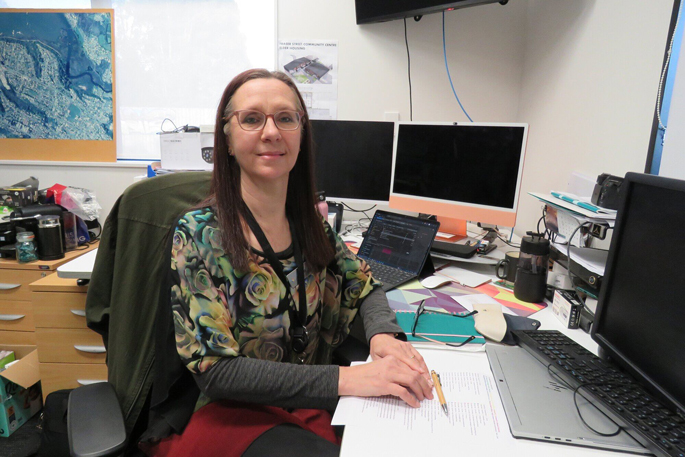
Merivale Community Centre operations manager Jen Murray. Photo / Merle Cave
Murray said the level of need was increasing. “Obviously, the new building creates a lot of opportunities for us, but we’ve seen numbers go up significantly.
“We used to operate out of a three-bedroom house, so it was limited in what it could offer ... but what we can do now is so much more visible.”
Murray’s team of eight paid staff, working fulltime and part-time, have to work out what services to offer, depending on funds. “We’re always hitting the ceiling of what we can get, and that dictates the staff and programmes that we can run.”
“Our operating costs are about $520,000 per year for business as usual. Each year we need to apply for everything.”
The centre has more than 30 volunteers, “and we wouldn’t be able to run without them”. “They do everything from sorting donations to helping at reception and on our after-school programme and kai distribution. They’re just incredible.”
The old centre didn’t record numbers, but Murray said, “Well over 550 people are coming through this centre a week”.
She estimated the old building would have seen about 100 a week.
“On kai distribution day, we used to see 30-40 people needing support; now we see about 100 on a Monday. This peaks at 140 during Christmas-New Year.”
Societal pressures were increasing. The cost of living was, unsurprisingly, impacting all parts of the community.
“It’s getting harder and harder out there, and we always say to people, ‘Make sure you pay your rent and your power because if you lose those there’s not much we can do to support that, but we can help you with clothing, food and household goods.”
Food was one item people could cut back on, “so kai resilience is a massive issue”.
“On kai distribution day, we see double-income families struggling because, even on minimum wage, with a family, it’s really tough ...”
Once people become homeless, more issues come into play. “We do get homeless coming through … They just want a place where they can feel safe, not be judged, and maybe belong for a little bit.”
About 70% of visitors came from Merivale or surrounding areas. An estimated 5% were homeless. The rest were from slightly further out.
Many visitors were people “who society is not fair to, for one reason or another”. Murray said much work was done with disadvantaged youth, who were disengaged from school, often for a multitude of reasons.
She wants the awareness campaign to show the heavy workload they’re doing to build up their communities, which in turn makes society a better place for all.
“Just how much we do, how busy we are, the effect we’re having on the community, because we see a lot of value in the work we do in the community. We believe it has a really positive impact on people and that has a flow-on effect.

Three dogs, visiting Merivale Community Centre. Photo / Merle Cave
“If people know that they’re safe, they belong, they’re getting help and can connect with services they need, that lifts pressure from other services and means these people are less likely to head into other troubles.”
Murray said the centre had a small Oranga Tamariki contract to fund part of its social and youth workers’ wages, “but the rest we have to raise ourselves”.
Every non-profit organisation was scrambling to secure the same grants, which made it difficult to gain support. Any donation this month would be well used, she said.
“Every little bit helps. It really does. For our community meal, we can feed more than 100 people for $200, so even contributing $20 to that goes a long way.”
To support the community centres’ campaign, visit www.BOPComCentres.nz or call into your local centre.