
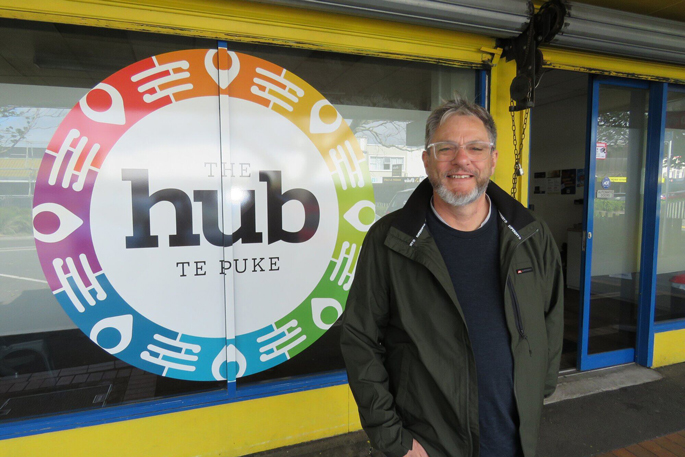
This month, five Tauranga-Western Bay community centres are running an awareness and fundraising campaign to future-proof their existence. It is shining a light on centres at Merivale, Welcome Bay, Gate Pā, Katikati and Te Puke. This week, Merle Cave visits The Hub in Te Puke.
The Hub Te Puke is operating from temporary premises at 130 Jellicoe St until next year, when renovations on its former home will be complete. But the change in location hasn’t slowed the demand for services.
When chief executive Scott Nicholson began in his role eight years ago, The Hub’s annual operating budget was about $120,000. Since then, it has endured a catch-22 of sorts.
“I did a lot of work in terms of raising our profile, making sure people knew what we did in the community, and with that more people began walking through the door and feeling comfortable to reach out for help.
“So, there’s the combination of more people struggling – that’s just the reality with fuel and food prices the way they are – and the more people know about us and the work that we do, well that also brings more people as well,” he said.
“We’re servicing in a day what we used to in a week, and we’re servicing in a week what we used to in a month.”
The Hub is open to the public from 9am to 2pm on Mondays, Wednesdays and Fridays.
“It’s the one door that anyone can walk through [in Te Puke], whenever they’re facing circumstances they might want help with. We will either provide the support if we offer it, or we can refer to other agencies.”
As such, The Hub is more of a social service than a community centre, Nicholson said.
“We operate in five main areas.”
The first is food and household resources.
“Food support is the number one reason that people walk through the door,” he said.

The Hub’s foodbank manager Clare Cooper and receptionist Heather Chaplin packing food parcels. Photo / Luke Edwards
The Hub operates its own food rescue service with local supermarkets and food stores and relies on donations from the community. The Hub will also find household items for people who need them.
“Linen, beds, furniture, kitchen items … we try not to have it on hand so instead we put a call out to the community and get a good response.”
Another area is housing support. “We can’t provide people with houses, but we do provide navigation of the housing system. Last year we successfully rehoused 21 households, which is no small feat.”
Advocacy across government agencies and businesses is a key area.
“There’s advocacy available for our clients with government agencies such as the Ministry of Social Development [MSD] and ACC. We also have a retired insurance agent who helps people with making claims with their insurance companies.”
Nicholson, who is on the regional Mayors Taskforce for Homelessness, said advocacy also happened on regional, political and national levels.
Drop-in services and a community cafe; and The Hub’s education and mentoring and social work round out the five areas.
Nicholson said the biggest need The Hub meets is in food support.
“On an average month support requests were at the 60% mark. Since the beginning of 2026 that’s been over 80%. Last month it was 93%.”
Nicholson said cost of living pressure was driving need. “Food is also the easiest part of people’s budget to flex. If they’ve got big car bill or power bill, they have to pay it but they can put the brakes on food.
“What we tell most clients is never stop paying your rent, never stop paying your mortgage. Whatever you do, keep that roof over your head because that’s the hardest thing to get back if you lose it.”

The Hub Te Puke housing navigator Tangi Walker with a client. Photo / Luke Edwards
Asked why The Hub is a special place, Nicholson said there was nowhere else in Te Puke that offered the walk-in support it does.
Even if people don’t need food or services, they may crave social interaction. “Our rough sleepers are in every day we’re open. We know that community well.”
Nicholson’s last report counted 122 rough sleepers of no fixed abode in Te Puke. Their needs changed from one individual to the next, he said.
“It can be anything … I think mental health is one of the biggest contributors and issues there.”
The Hub’s support for homeless people is tailored to their specific needs. For example, food packages for the homeless are different from those for the general population.
“It’s got to be stuff that can be stored without a refrigerator, it needs to be pre-cooked. If they’re on our koha system, they write a list. Many pick up food 2-3 times a week.”
To give a snapshot of The Hub’s work, in August it supported 134 households with food. This included 22 whānau who were first-timers.
Also, 3466kg of food was distributed – which included 2711kg of rescued food – 131 volunteer hours were worked and 240 client interactions were made beyond food.
The Hub has six part-time staff and 34 volunteers who keep the facility ticking.
“We couldn’t do it without our volunteers,” Nicholson said. “They’re absolutely amazing and most have been here long term.”
Staff from Bay Financial Mentors, Baywide Community Law and MSD also work in The Hub but were employed by their respective organisations.
Nicholson said it takes about $600,000 to operate The Hub annually. His job is focused on ensuring funding came in.

The Hub Te Puke chief executive officer Scott Nicholson with a food parcel. Photo / Luke Edwards
“TECT, the Acorn Foundation, BayTrust and the New Zealand Lottery Grants Board provide about one-third of that between them.
“Local businesses provide about one-third, about 5% is from government contracts and private individuals fund the remainder. They could give as little as $10 a month.”
The Hub struggled to secure the $600,000 each year. “We nearly closed two years ago because of that,” Nicholson said.
For those who don’t know much about The Hub, he wanted readers to know it was needed.
“It is a community meeting the community needs – and, as a community, I think we’re best positioned to understand what’s needed locally in terms of a local response to things.
“At an individual level, we all hit speed bumps at times in life, and if we’re privileged enough to have family that can help us through that, that’s great. But not all of us have family in that position.
“One of the things my mother always said is you’re only as happy as your unhappiest child. I think as a community we’re only doing as well as the most struggling person.”
Nicholson said The Hub’s offerings don’t alter much day-to-day because it does not run programmes.
“It’s probably better to think of The Hub as a social service as opposed to a community centre.
“Whenever we’re open, we aim to provide social services to the community. The majority of people who walk through the door would engage with a social worker.
“We’re intentional about that because they’re people who are listening with a professional ear.”
People usually present with one issue, but it’s related to or stemmed from other concerns. The Hub aims to provide wraparound support for their wider situation, Nicholson said.
“We ask them what else is going on? What else can we help with? About 85% of people who connect with us, are connected with another service within 30 days.”
To support the five community centres’ campaign, visit www.bopcomcentres.nz.