
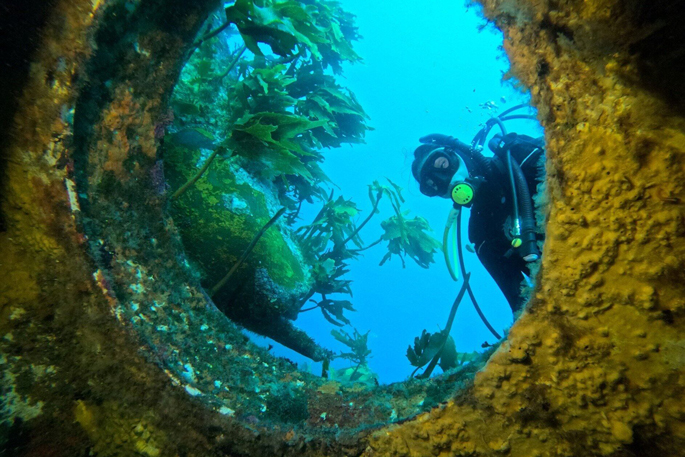
Dr Phil Ross remembers a time when diving Ōtāiti / Astrolabe Reef meant swimming through what looked like a scrap metal recycling yard.
“You could go for a 40-minute dive and never see the sea floor because all you saw were flattened containers, steel and all of the material that had come out of the Rena wreck.”
Today marks 15 years since MV Rena ran aground on Ōtāiti on October 5, 2011, spilling about 350 tonnes of heavy fuel oil into the Bay of Plenty.
For the past 15 years, the former University of Waikato marine ecologist and his team have monitored the ecological effects of the Rena grounding at Astrolabe Reef, under contracts with Bay of Plenty Regional Council and, at various stages, the Rena’s owner and insurer.
Ross had not dived at Ōtāiti / Astrolabe Reef before the Rena disaster. Soon afterwards, he dived at other reefs around Mōtītī to get a sense of what a relatively unaffected reef looked like, providing a comparison for his subsequent monitoring of Ōtāiti.
Ross said that since October 2011 he’d made more than 300 dives at the reef, monitoring its recovery and the condition of the wreck that remains on the seabed.
What he sees today is dramatically different.
“The fish life is amazing. The biodiversity and the vibrancy of life on Ōtāiti is every bit as good as the other offshore reefs in the Bay of Plenty.”

Megan Ranapia (University of Waikato) surrounded by blue maomao at Ōtāiti / Astrolabe Reef. Photo / Phil Ross
In January 2012, the Rena container ship separated into two pieces and eventually began to sink.
It was labelled New Zealand’s worst maritime environmental disaster, and the salvage operation was the second most-expensive in the world at $700 million – paid for by the insurers of the Rena’s owners.
The salvage operation and clean-up work ended in April 2016 while environmental monitoring work continued.
Good news
Ross said that today the reef is supporting a thriving and diverse marine ecosystem, with large numbers of snapper among the most obvious signs of its recovery.
“Whenever we’re diving, good-sized snapper are swimming around us, coming up and checking us out. And on the edge of your vision, they’ll be big snapper up to 30 or 50 years old, just hanging out.
“And every now and then one of them will swim in and have a look at you.”
For Ross, it is evidence of what a healthy reef ecosystem can look like when it is given the opportunity to recover. “It’s such a good news story,” he said.

Diver David Culliford (Toi Ohomai) surveying the organisms and ecology of the reef at Ōtāiti / Astrolabe Reef. Photo / Phil Ross
Ōtāiti is now part of the Motiti Protection Area, where fishing is prohibited and diving is permitted.
Ross said recent comparisons with other reefs around Mōtītī found Ōtāiti had biodiversity and ecological health comparable with the surrounding reefs.
Copper wiring
The wreck remains an important part of the monitoring, particularly because of copper wiring originally from building destroyed in the Canterbury quakes that went down with the stern of the Rena. “It was one disaster feeding into another,” Ross said.
A significant amount was recovered during the salvage operation, but some remains beneath the wreck where it cannot be accessed.
“We’re monitoring so if the wreck moves and the copper is exposed, then some decisions could be made about trying to recover it.”
Ross said a major storm this year produced swells of about 10.5m, but the main wreck and the copper beneath it did not move.

Megan Ranapia (left) and Phil Ross with blue maomao, Sandager's wrasse and snapper in the background at Ōtāiti / Astrolabe Reef. Photo / Phil Ross
Sediment samples are collected from sites around the former debris field, as well as further away from the wreck, and are tested for copper and contaminants associated with anti-fouling paint.
Kina are monitored as an indicator of contaminants entering the food chain.
Water chemistry testing around the copper has also shown that its influence has not expanded beyond the area identified in earlier monitoring.
A focus
While the wreck remains a focus, Ross said the reef’s recovery had increasingly become the more remarkable story. Some pieces of wreckage weighing tens of tonnes left in shallower water near the top of the reef had been moved by storms.
“It’s really showing you the power of the ocean.”

The container ship Rena pictured where it struck Astrolabe reef off the coast of Tauranga at about 2.20am on October 5, 2011. Photo / Alan Gibson
Yet when wreckage is moved, the reef underneath can recover surprisingly quickly.
“When these bits of wreckage get moved off, within a few months we see a seaweed forest starting to grow on the reef.”
He said some sections of wreckage were now so covered in marine life that it was difficult to distinguish between ship and reef.
“I don’t have any long-term concerns. I’ve seen it at its worst, I’ve seen the trajectory of recovery and where it is now is quite amazing,” Ross said.
“It’s a really good lesson in the resilience of the ocean and the ability of those reef ecosystems to recover from disturbance.”

MV Rena separated into two pieces and sank on Astrolabe Reef in January 2012. Photo / Brian Rogers
The reef continued to support a wide range of marine life, including jack mackerel, kahawai, kingfish, moki, Sandager’s wrasse, butterfly perch, blue maomao and the occasional manta ray, Ross said.
“The wreck is fantastic to see, but it’s actually all of the reef around the wreck which is really spectacular.”
Special place
Even in the aftermath of the disaster, areas near the wreck continued to thrive.
“Around the corner from where the shipwreck was, there’s a beautiful steep cliff, covered in sponges and anemones and vibrant life.”
However, there are still challenges facing Ōtāiti. Ross pointed to the increasing abundance of long-spined black sea urchins in the Bay of Plenty as a wider environmental concern associated with warming waters. But it is not a Rena-specific issue.

Megan Ranapia dives near a reef wall covered in colourful invertebrates on the north side of Ōtāiti / Astrolabe Reef. Photo / Phil Ross
After 15 years of diving, Ross said the transformation remains remarkable.
“It would be better of course if there was no shipwreck there,” he said. “It’s an amazing recovery, a great demonstration of how all those different parts of the ecosystem can recover if they’re given that opportunity.”
Ross said the current resource consent is due to end next year, with a planned handover of responsibility for the wreck and its ongoing management to Bay of Plenty Regional Council.
For now, Ross continued to dive, monitor and watch a reef that had changed almost beyond recognition over the 15 years since he first descended on to the reef after the Rena disaster.
“When you’re out there underwater, it’s a pretty special place to be,” he said.
*Disclaimer: The Weekend Sun journalist Rosalie Liddle Crawford was the producer of 2023 locally made film Taking Back Our Beach, which documented the Bay of Plenty community’s response to the coastal disaster after the grounding of the MV Rena in October 2011.