
Five Tauranga-Western Bay community centres have run a recent awareness and fundraising campaign to future-proof their existence. It’s shining a light on centres at Merivale, Welcome Bay, Gate Pā, Katikati and Te Puke. This week, Merle Cave visits Katikati Community Centre.
Katikati Community Centre’s hall is packed. Laughter warbles from the room full of seniors about to begin the Wise & Wonderful activities held for those 65-plus every Tuesday.
The games come out, the room hushes, and I get a centre tour by manager Nicky Austin.
For more than 30 years, the centre has offered information, services and support in education, social services, health and wellbeing to the small but rapidly growing, diverse population of Katikati.
Regular services include driver licensing, Alzheimer’s support, Justice of the Peace drop-ins, B4 School nurse checks, Grey Power meetings, free legal advice and budgeting help.
For health, there’s a chiropractor, hearing and vision tests, first aid training, podiatrist, a respiratory clinic and more.
In partnership with Good Neighbour, the centre collects unsold food from Katikati Woolworths to support the local food bank, Tamawhariua health and social services provider, Kurakai, a free weekly Community Breakfast, Thursday Students’ Pancake Day, and the Patuki Kai food stand outside.

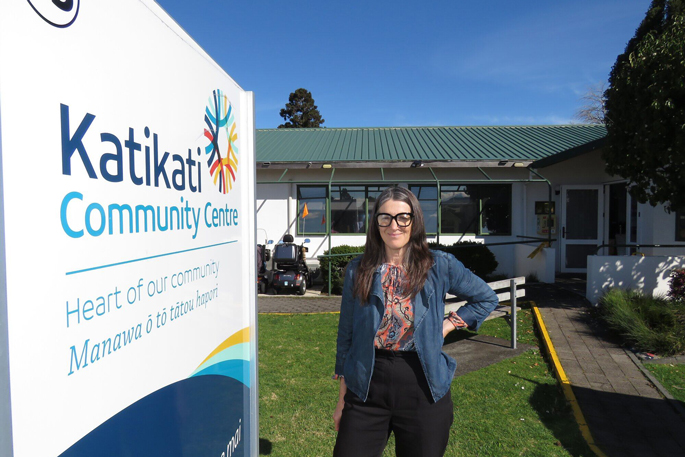
Jan de Faye of Katikati Community Centre. Photo / Merle Cave
The centre runs adult education courses on everything from te reo Māori, antenatal and cooking to devices workshops and Rongoā holistic healing.
The centre’s Katikids holiday programme runs between school terms. Other free events driven by the centre include picnics, charity breakfasts and potluck dinners.
The centre’s vision is to create a thriving, connected community. Its mission is weaving people together.
Austin said the centre sat on Crown-owned land, but the building was owned and run as an independent community centre by a charitable trust.
Austin said it costs about $650,000 to operate the centre annually – and trying to gain funds to keep it running is “absolutely constant”.
“It is funded via central or local government service contracts [Ministry of Social Development, Oranga Tamariki, Oscar, Te Whatu Ora, Western Bay of Plenty District Council, Corrections] about 62%, philanthropic funding grants count for about 15%, room bookings make up about 19%, but there’s always a gap that we’re trying to fill.
“I feel we are struggling – staff member Rochelle Morrow’s community advocate role we pay for out of our own pocket. We won’t be able to continue doing that for years and years and years.
“I do want to emphasise that we are independent. Many people think we are owned by council – we are not.”
Like fellow community centres in Tauranga, Austin said Katikati is jockeying for grants alongside other worthy organisations.
“Every year we ask ourselves, ‘How the hell are we going to keep this going?’ But without that service the people who are most vulnerable have absolutely nowhere else to turn.
“So we desperately keep trying to find a little bit of money here, a little bit of money there.”

Katikati Community Centre manager Nicky Austin, with team leader Jan de Faye and receptionist Tracey Burton welcome anyone and everyone. Photo / Merle Cave
The centre is staffed by six fulltimers and two part-timers, plus up to seven school holiday programme staff. Volunteers number 30-odd. “We couldn’t survive without volunteers – we’re really lucky,” team leader Jan de Faye said.
The centre has a hall and adjoining kitchen, reception and a rear meeting room that can be accessed separately for agencies such as Oranga Tamariki Ministry for Children.
A consult room is dedicated to Corrections’ probation services; another is used for podiatrists, a chiropractor, haircuts for koha, counselling services, etc. The staff office now sits at the front of the building.
“Since we’ve moved our office, we’ve really got to see how many people do come into reception literally just for a yarn. Sometimes people really offload about something they’re really struggling with. It’s much more than advising people,” Austin said.
“If people ask for something our reception staff will ask them, ‘what’s going on?’ and, ‘is everything all right?’ and it will come out that there’s actually a hell of a lot going on,” Austin said. “And we help them from there.”
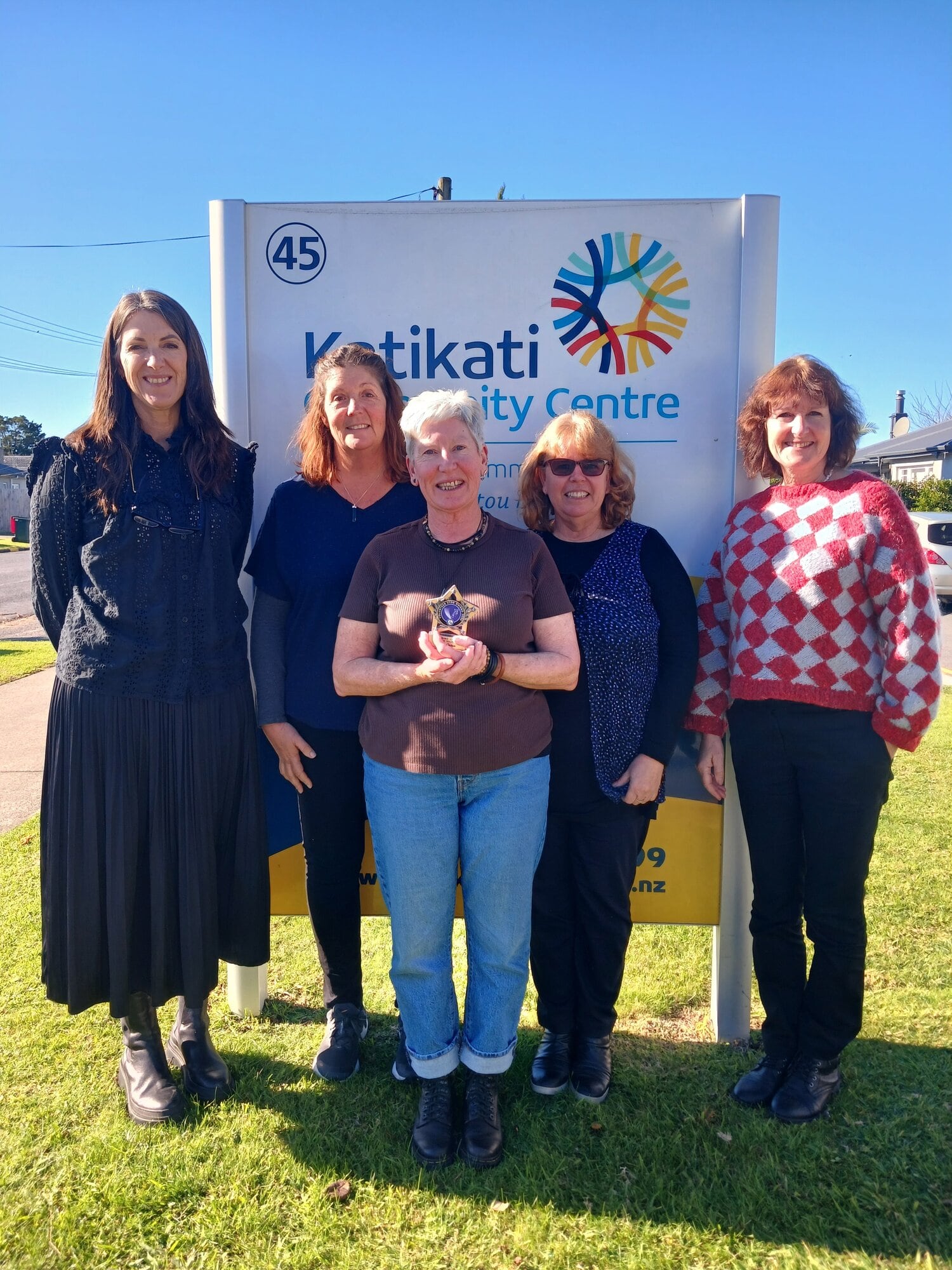
Katikati Community Centre staff Nicky Austin, Rochelle Morrow, volunteer Shona Graham, with Jan de Faye and Sally Goodyear at work on a Katikati Spring Clean. Photo / Supplied
The centre’s food rescue contract is partly funded by the council, which also funds the reception/information services.
Food is collected via a Good Neighbour licence, which allows staff to weigh and sort it under strict rules before distributing it. Whatever is left goes to Patuki Kai. “We dribble it out during the day,” de Faye said.
Food parcels were made as needed. For example, frozen meals for those aged 65-plus. “We’ve got a good number of regulars who come for those,” de Faye said.
With the cost of living “tougher than it’s ever been”, Austin said food demand is high. “I didn’t even think it could get any tougher than six months ago, but it has. The screws are on so tight for everyone,” she said.
“People are struggling. We see the Patuki Kai is busy, busy, busy.”
But that’s a positive. “Many people drop things off too. I love the fact that people are adding to it themselves and getting that feeling of giving to the community.”
Austin said each contract the centre held had requirements it had to meet. “Every contract we get we have to prove that we have achieved the outcomes we are being paid to do.”
Why is the centre needed? “Katikati’s community centre, I feel, is the glue that holds this community together. There are so many things that we provide people that increases their quality of life.”
Austin saw the joy community members receive daily from the services and offerings within the centre. Wise & Wonderful is a highlight of the week for many seniors, she said.

Katikati seniors enjoy Tuesdays’ Wise & Wonderful activities at the community centre. Photo / Merle Cave
“Just being the place to come where people need a bit of support, a kind word, a hello, a cup of tea, it really is needed.”
Austin said Katikati is located more than 36km from Tauranga CBD. The commute, because of unpredictable State Highway 2 traffic, could take 30 minutes or up to two hours.
“We’re finding travel is a barrier – and because we don’t have a Winz or MSD office in Katikati, we [the community centre] become an agency for many services… We’ve become the agency for everything.
“Everything falls back on us, so it’s a busy, stressful and demanding role – but we see the benefits we bring to the community.”
Austin believed a community was only as successful as the way it took care of its most vulnerable.
“Without our centre helping our most vulnerable we wouldn’t be moving along very fast at all. That’s how I see it. There has to be a mechanism for looking after the people that struggle to look after themselves for whatever reason.
“Maybe they don’t have family here, have lost a significant other, don’t have the knowledge or know where to go for help – any number of different scenarios...Maybe they’ve got themselves into a pickle and are too embarrassed to reach out for help.
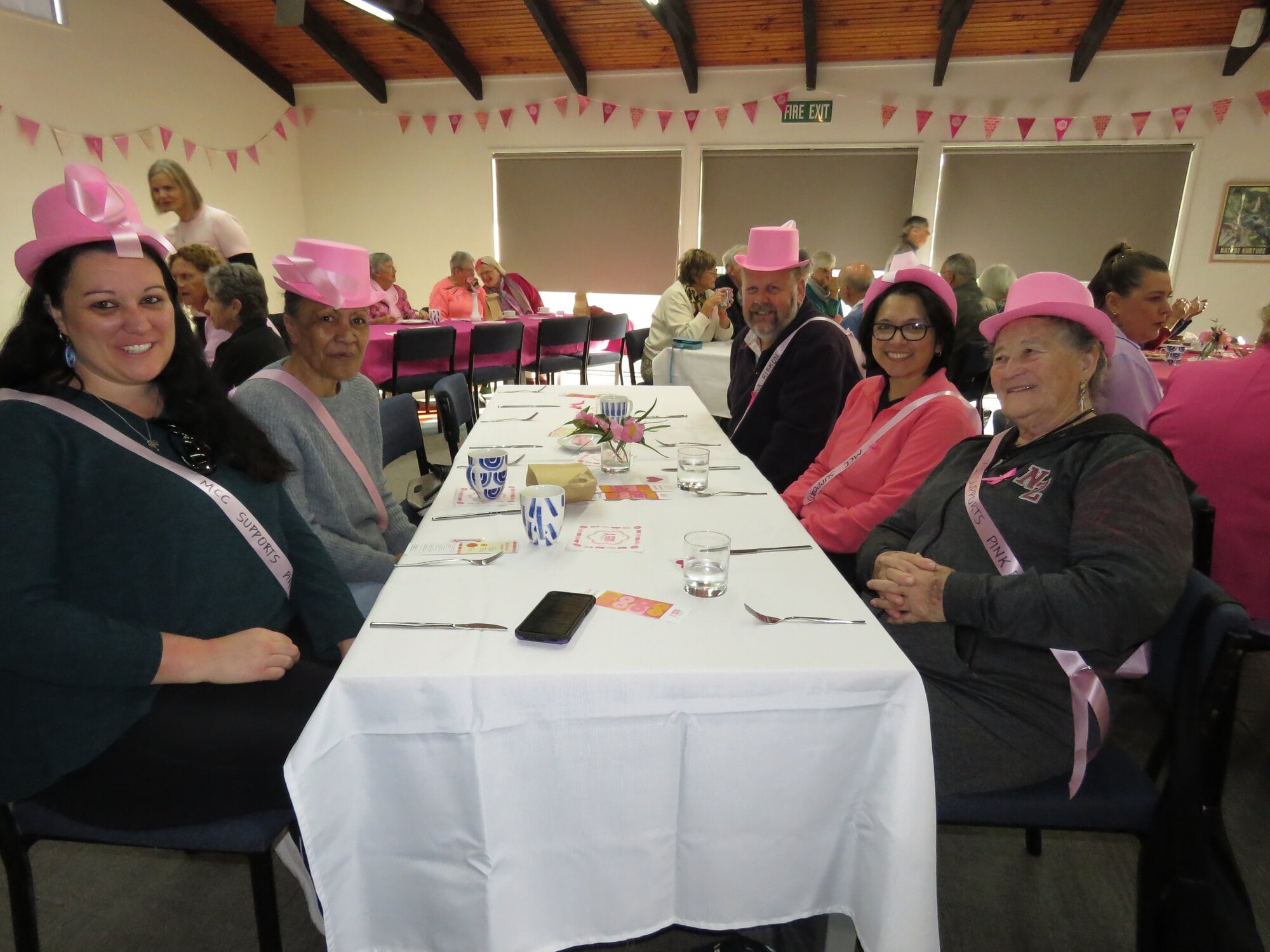
The pink hat group is Merivale Community Centre staff, who came out to Katikati to support the fundraising of a fellow community centre. Photo / Merle Cave
“If we don’t look after and help these people – often it’s just a 20-minute conversation and the problem is easily fixed, whereas for them it’s huge – I really hate to think what this community would look like without this community centre. It would leave a massive hole.”
The community centres’ campaign has a website to learn more and make donations, visit: www.bopcomcentres.nz
Donating a small amount would make a huge difference in Katikati, Austin said. “A little bit might help a kid receive a piece of uniform, buy the biscuits for Wise & Wonderful, or pay for gas for a week to pick up food rescue items.”