
Waihī Beach’s surf club is mourning the loss of one of its most treasured members, whose extraordinary contribution to lifeguarding and the wider community spanned more than seven decades.
Ian Arthur Robinson was born on January 17, 1935. He died peacefully, aged 91, on October 13.
Affectionately known as “Robbie”, Robinson joined the club in 1953, aged 18, and became a champion athlete, pioneering surf lifesaver, mentor and dedicated volunteer, Waihī Beach Lifeguard Services Inc board member Natalie Lloyd said.

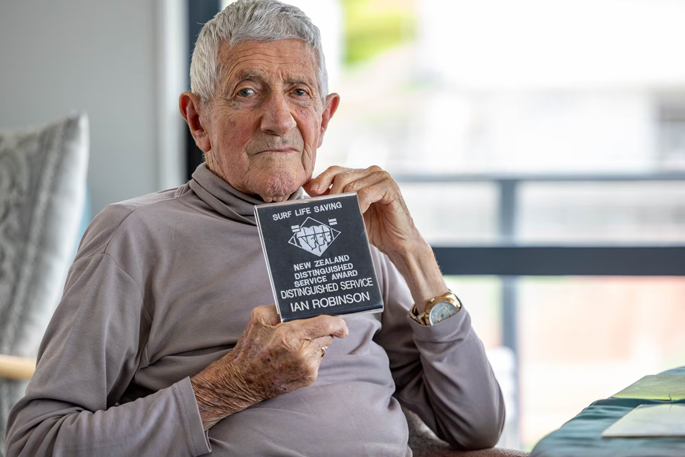
Ian Robinson was a Waihī Beach surf club member since 1953. Photo / Jamie Troughton Dscribe Services
“Ian went on to serve 30 years as patrol captain and [gave] more than two decades coaching and instructing generations of lifeguards,” Lloyd said.
“One of his most significant contributions came in 1979, when he was selected among 12 New Zealand surf lifesavers to undertake specialist Inflatable Rescue Boat (IRB) training in Australia.”
He subsequently helped introduce and develop IRB rescue operations in New Zealand, including serving 17 years on the national IRB Examiner Committee.
“Ian’s generosity extended well beyond surf lifesaving, including 45 years volunteering with Waihī Police search and rescue and more than 30 years supporting the Waihī Beach Fun Run, and helping with the New Year’s Day Beach Sports and Sand Making competitions,” Lloyd said.
“A long-time Justice of the Peace, he also supported charity outings, chopping firewood, sharing produce or delivering Christmas dinners to those in need.”
In 2020, Robinson received a Surf Life Saving New Zealand life membership and a Queen’s Service Medal, recognising his exceptional contribution to his community.
“Yet it was his quiet generosity that defined him. Even into his later years, Ian made regular evening visits to the clubhouse, checking equipment and ensuring everything was secure.”
Lloyd said his legacy continued at the club through the Robinson family’s longstanding involvement in surf lifesaving.

In New Plymouth in 1966, from left Dan Harris, W Clark, D Moore, D Lindsay and Ian Robinson in action. Photo / Supplied
“Together with his late wife Heather, who supported his lifelong involvement in the club, Ian raised four sons – Bruce, Neil, Danny and Glenn – who have each shared in the family’s longstanding connection with Waihi Beach surf lifesaving.
“That commitment has carried through to the next generation, with grandsons Mitchell and McLeay continuing to be actively involved in the club, with their father, mother and uncles.
“Waihī Beach Lifeguard Services extends its deepest sympathy to Ian’s family and remembers a remarkable gentleman whose kindness, humility and unwavering commitment helped shape the club for generations,” Lloyd said. “Rest easy, Ian. Your watch is done.”
In his obituary notice, Robinson’s family said they were very proud of him. “A full life, well lived and an inspiration in word and deed to his family and community at Waihī Beach.”
A memorial service for Robinson was held at the surf club on October 20.
As a tribute to Ian, Katikati News is reprinting an article journalist Merle Cave wrote about him in November 2025, ahead of Waihī Beach Lifeguard Services Inc’s 90th anniversary.
Ian Robinson’s unwavering commitment to his club
There’s a saying in New Zealand’s surf life saving community. “In it for life”. Waihī Beach resident Ian Robinson reckoned the mantra definitely applied to him. “Yep, it’s a good saying!”
Aged 90, his memory is not as good as it used to be – but he remembers the important stuff when it comes to talking about his 30-odd years of involvement in Waihī Beach Lifeguard Services Inc (WBLGS) – which many know as Waihī Beach Surf Lifesaving Club.

The 1957 nationals in Wellington was attended by Doug McLeay, Colin Major, Ian Robinson, Dan Harris, Graham Hales and Doug Seath. Photo / Supplied
Ian, who sat down with son Danny for a video interview with Jamie Troughton of Dscribe Media Services, is a life member of WBLGS.
Ian, 18, was living in his family’s home up the hill at Waikino in 1953.
“I joined up [to WBLGS ] with some of the guys that were around – and I ended up being in charge of them all,” the nonagenarian said.
‘I will lead it’
“They all said: ‘Oh, you’ll get lost here and you won’t know what to do’. So I said: ‘Well, I will lead it to start with’. And that’s what I did.”

Ian Robinson has been a mainstay at Waihī Beach Surf Life Saving Club for 72 years. Photo / Supplied
Ian’s day job was selling shoes in two local stops – but he often popped into the club to keep an eye on things. Over the years he became known as “Robbie” at the club – anything that needed sorting out, the saying was: “Just call Robbie; he’ll fix it.”
His mechanical knowledge was learnt from a prior workshop job in Kinleith mill in Tokoroa. “I just transferred my knowledge to the surf club,” Ian said.
He spent much time helping others learn the ropes – and when he wasn’t on the sea or sand, he was “playing rugby”.
Danny joked that surf club activities were Ian’s training for the rugby field. “It was a very good recreation ground and it had everything you wanted for sports,” Ian said.
Danny said anything that was on the beach his father and friends loved. “Yep,” said Ian, who thought he was a good swimmer.
Bruce’s Bone
One early highlight was an annual competition between Waihi and Piha surf clubs. “It was called Bruce’s Bone. It was an old bone stuck onto a shield. Piha would come down and do a raft of competitions with us – from boats to swimming to ski – and the winner would get Bruce’s Bone. Bruce was my brother.”
Ian and Heather had four sons – Bruce, Neil, Danny and Glenn – who’ve all been associated with the club in varying degrees. Ian’s grandsons – Mitchel and Mcleay – are current active members.

Ian Robinson and son Bruce in uniform on the beach. Photo / Supplied
Danny said his father started Bruce’s Bone. “It went on for years and years. It was an old cattle bone. If I remember rightly, Bruce found the bone on the beach.”
First nationals
Waihī Beach attended their first national surf life saving competition in Invercargill in 1957 with Ian in the mix. A group from Waihī Beach travelled down – about three carloads with skis and things tied on top of their cars. “She was a mighty expedition, stopping at every watering hole they passed,” Danny said.
“It was good trip,” Ian said. “With the training we did and the people we met we learnt a lot.” Ian won the beach sprint. “It was bloody cold,” he said of the water down south.
One of his favourite surf club moments was the 1970 Piha surf championships when he won medals in the canoe. “Usually the canoe team just turned up and had a paddle, but Dad saw the opportunity and rounded up a team of guys.”
Danny remembers going with his mother Heather (nee McLeay) – also a WBLGS member along with father Pat McLeay – in the cold of night to pick up his father from the beach – who was running up and down with his canoe crew “trying to get fit”.
“A few years’ running they won the BOP heats, Northern regionals, and got to the nationals, and I recall Whakātane being the nemesis,” Danny said. “But they got a couple of silvers and bronzes at couple of consecutive nationals – so they did very well for themselves. But it was a matter of somebody taking the lead.”
Unusual
“You had to tell them that they had to do it,” Ian said.
“Nowadays this is part of your training but 50 years ago it wasn’t what you did. It was unusual,” Danny said.
As for lifeguarding, what is Ian most proud of? “Carrying out very efficient rescues,” he said. “It was up to everybody to know what to do and how to do it.”
Ian said nearly all early rescues were done with reels. “Someone swam out to the person to ensure they weren’t drowning and when the ski or canoe got there – that’s when we rescued them.”
Back then rescues were a graduated style of job – Ian did all roles. “The biggest thing of the lot was making people feel secure,” he said.
WBLGS was one of the first lifesaving clubs in New Zealand to get Inflatable Rescue Boats (IRBs).
Recommending IRBs (sidehead)
Ian was part of a Surf Live Saving NZ (SLSNZ) investigation tour to Australia in 1978, and returned with a recommendation for New Zealand to adopt IRBs.
Ian is happy the club went with IRBs rather than jetboats. “[With jetboats] You were always getting the bloody things fixed!”

Ian Robinson with IRB learners. Photo / Supplied
Ian started a training system, so surf club members had to qualify before they could drive an IRB, said Danny. “It was part of a sea change happening in surf lifesaving at the time. Beforehand, anyone could grab a canoe and go down the beach [to rescue someone].”
Part of club work was IRB maintenance. “All the guys had to know this so they could sort the engine out so they didn’t have to call someone out to fix it,” said Ian. He spent many hours showing fellow clubbies how to maintain club gear. His calling was to help “guide others”.
In a hairy moment in 1983, Ian was the IRB driver who went out in severe storm conditions to look for someone reported to be in difficulty in the surf off Orokawa Bay. The person made it to shore, but the IRB boat was swamped in huge surf. The crew swam to shore, the boat was “lost” until it was found washed up on Mercury Island three months later.
Still involved
Ian said he was proud of his involvement in WBLGS for 72-odd years, still being involved with support needs. His involvement meant he’d helped and saved many people over the years on the sand and in the water.

Ian Robinson, taking a trip down memory lane of his 30-odd years on the job at Waihī Beach Surf Life Saving Club. Photo / Jamie Troughton Dscribe Media Services
“Occasionally, people came up and thanked me, sometimes years later, or their family did.”
Was that a nice feeling?
“Oh yes, very much so.”
Ian holds a SLSNZ distinguished service award.
He was the club’s oldest member.
The Weekend Sun thanks Jamie Troughton of Dscribe Services for his video interview of Ian Robinson, which formed the basis of this story.