
For years after breast cancer treatment, Deb Turbitt felt like she was walking along a beach waiting for the disease to jump out from behind a rock.
Eventually, she learned to imagine breast cancer walking beside her instead.
The analogy helped Turbitt come to terms with the fear that had followed her since her diagnosis five years ago and now shapes the way she supports other women through theirs.
Turbitt had found harmless lumps before, so when she noticed another in December 2020, she nearly dismissed it.
She was 39, with two young children and living through the uncertainty of Covid-19 when she was diagnosed with triple-negative breast cancer – an aggressive type of invasive breast cancer.
“Absolute disbelief. Really just disbelief and just fear ... I didn’t want this to be happening to us.”
Turbitt was working part-time as a chiropractic assistant and her partner had been made redundant during the pandemic.
She started intensive chemotherapy in January for about six months, followed by a double mastectomy in July 2021.
The first round sent her to A&E with vomiting. She lost her hair, battled fatigue, and had to explain to her children what was happening.

Deb and her sister Cindy during Deb’s treatment.
Turbitt’s stepdad had died of cancer a year earlier, and her 9-year-old son knew what the word could mean.
“I didn’t want to lie to them and I didn’t want to scare them.”
Her mother moved in after the diagnosis, attended every chemotherapy appointment and cared for her when she was sick, while friends cooked meals.
“They really did get me through.”
Treatment took about nine months, and Turbitt got through it “day by day, week by week, step by step”.
She said the fatigue lingered, the support fell away and people kept telling her how well she looked, while she felt otherwise.
“There’s an internal struggle going on that people don’t see.”

Deb pictured with her kids on her birthday, 18 months after treatment.
One of the most useful pieces of advice she received came from a breast care nurse during treatment.
“She said it’s a bloody nuisance, but you just have to do what you have to do and then you get on with your life.
“There was that moment where I was like, wow, this isn’t forever. There’s going to be me on the other side of this.”
Turbitt talked about how learning to live beyond the fear took time.
A recent clear CT scan was a turning point, letting her put the cancer further into the background.
“I felt like, okay, I can let this go now, properly.”
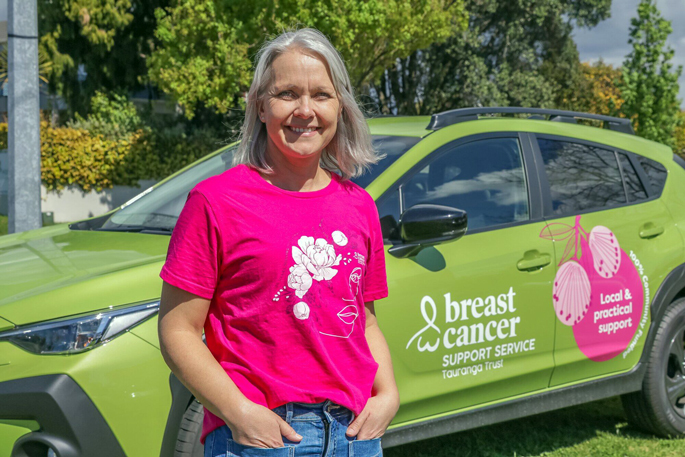
Turbitt is now a worker for the Breast Cancer Support Service Tauranga, helping women navigate the same diagnosis she once faced.
The service receives referrals, sometimes on the day a woman is diagnosed.
Turbitt and her colleagues phone patients to introduce themselves and offer practical and emotional support.
The service also runs a drop-in centre and support and coffee groups, provides meals and items such as post-surgery cushions, scarves and hats, and connects women with counselling and other services.

Breast cancer survivor Deb Turbitt now supports women through diagnosis and treatment. Photo / Kelly O'Hara.
Turbitt said her own experience helps her understand a part of the diagnosis that is hard to explain to those who have not lived it.
“You can hear in people’s voices when you tell them that you’re a support worker and you’ve been through this. You literally can hear the relief.”
The aim was to meet each woman where she was, without overwhelming her, she said.
“Most people realise, oh, this is a club I really wish I never had to join.
“But there are so many beautiful ladies you meet through this experience.”
Since her own cancer experience, Turbitt said her gratitude had stayed, with a deeper appreciation for her relationships.
The fear had not disappeared but had faded into background noise.
“It’s a real privilege to do this work.”
Zoe Blake is a multimedia journalist at the Bay of Plenty Times and Rotorua Daily Post.