
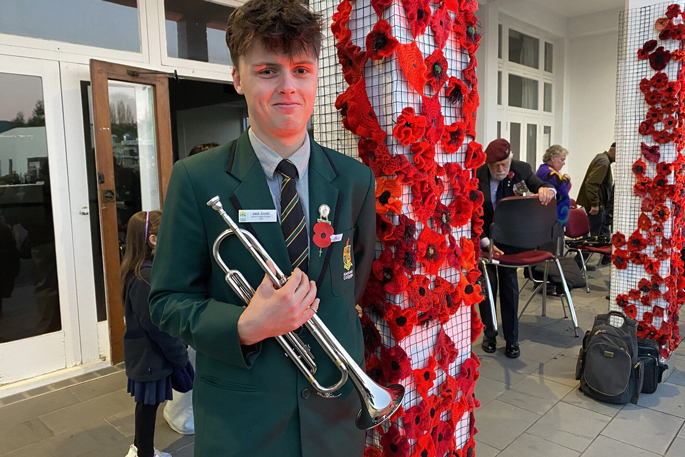
It’s that chilling, distinct sound, which follows a precise note composition that brings us to a standstill each Anzac Day at dawn.
Alone with our thoughts of those who perished, and those who lived but made sacrifices that we just can’t get our heads around.
Playing The Last Post on the bugle is probably the hardest job to do on Anzac Day – usually in front of hundreds of people waiting for every note.
This year it was Katikati College student Jack Smith’s turn at his town’s dawn service.
As people stood motionless and silence ensued just after 6am on Saturday morning, April 25, the 17-year-old nailed it – he didn’t falter. The well-known tune reverberated out flawlessly.
“Lucky I had a practice run yesterday,” Smith said, referring to his performance at Ōmokoroa Point School’s Anzac service. “I did have a bung note there – so it was good to get it perfect today, on Anzac Day.”
Ironically, the simple brass wind instrument with no valves produces sound via the player’s breath and embouchure, limiting its range to a few notes.
But there’s pressure to get those few notes right if you get called on to play the instrument on April 25.
“It [Anzac Day] is the scariest service,” the Katikati College deputy head student said.
“Days before, I’m terrified and [when I’m up there] I can tell myself I’m not nervous, but as I’m playing The Last Post, you can hear a slight wobble, and that’s me shaking.”
Smith said he began playing musical instruments when he was in Year 7.
“I sort of started playing by chance really. One day I got told, ‘Would you like to sign up?’ and I was like, ‘Oh, yeah whatever’ and I sorted of got hooked in from there.
“I played trumpet for two years and then I split into the French horn, the tenor horn, and from there that grew into the trombone, the flute, the saxophone, the clarinet.”
For him, playing instruments is an adrenaline rush. “It’s one of those things that when you play a really good piece of music – that gets your foot tapping – you feel really excited. That’s what I love about music.”
Recently, he attended the New Zealand Brass Band Championships 2026 National Contest from April 8-11 in Wellington, where he played the double B flat tuba as part of Tauranga City Brass Band’s B grade entry.
Smith said he played in the Katikati Concert Band as a youngster at a previous Katikati Anzac Day but not on the bugle.
“The band asked me to do Katikati’s [dawn service] this year because their well-known bugler Dennis Wilks was away,” Smith, who also played instruments with the Bay of Plenty’s youth orchestra, said.
But he is not totally new to Anzac performances. “I have played the bugle for Tuapiro Marae [on Anzac Day] for two years, and last year I was asked to do the Ōmokoroa Anzac Day service.”
Is it difficult to play the bugle? “It’s much like anything … it becomes almost like second nature in a way. I mean, at the start, yeah, it’s hard,” he laughed.
“It sounds terrible when you start, but once you sort of go for a little while, it just becomes sort of almost like walking.”
While high pressure, the Anzac Day task is an honour, Smith said. “Once you hit that highest note – because that’s the scariest note – you warm up and then you go cold, and you know you don’t play for a while …
“Then you have to come back in and you have to hit that high note on a cold bugle. But once you hit it, that sort of like, whoa, you know, you sort of get that wind in you.”
Despite his love for playing music, Smith plans to first go in a different career direction.
“My idea is that eventually one day I’ve loved to come back and be a music teacher, but my first career path is going to be in the physics direction.”