
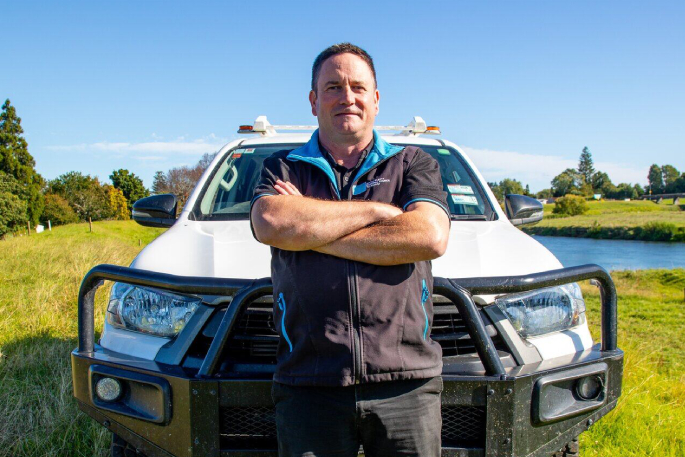
When the rain starts to fall, most people head for cover, but for Dan Batten and his team, they get stuck into their mahi (work).
They’re the engine room behind the maintenance of the Bay of Plenty’s flood protection network – a crew of long‑serving, hard-working problem-solvers, who know every bend of the region’s major rivers and many of the landowners along their banks.
In rain, shine and everything in between, Batten leads the people who make sure our flood defences, such as stopbanks, floodgates and pump stations, perform when we need them most.
Massive job
As rivers and drainage operations manager at Bay of Plenty Regional Council, Batten oversees the maintenance and management of its five major rivers and drainage schemes, and more than 30 minor pumping schemes.
“It’s a massive job when you start explaining it to people,” Batten said.
“We have more than 141km of stopbanks and 370km of drains and canals in the Rangitāiki Plains alone.
“From operating cutter paddle boats on the canals, desilting drains, repairing flood damaged infrastructure and now adapting to new technology like drones – it’s a lot to get through.”
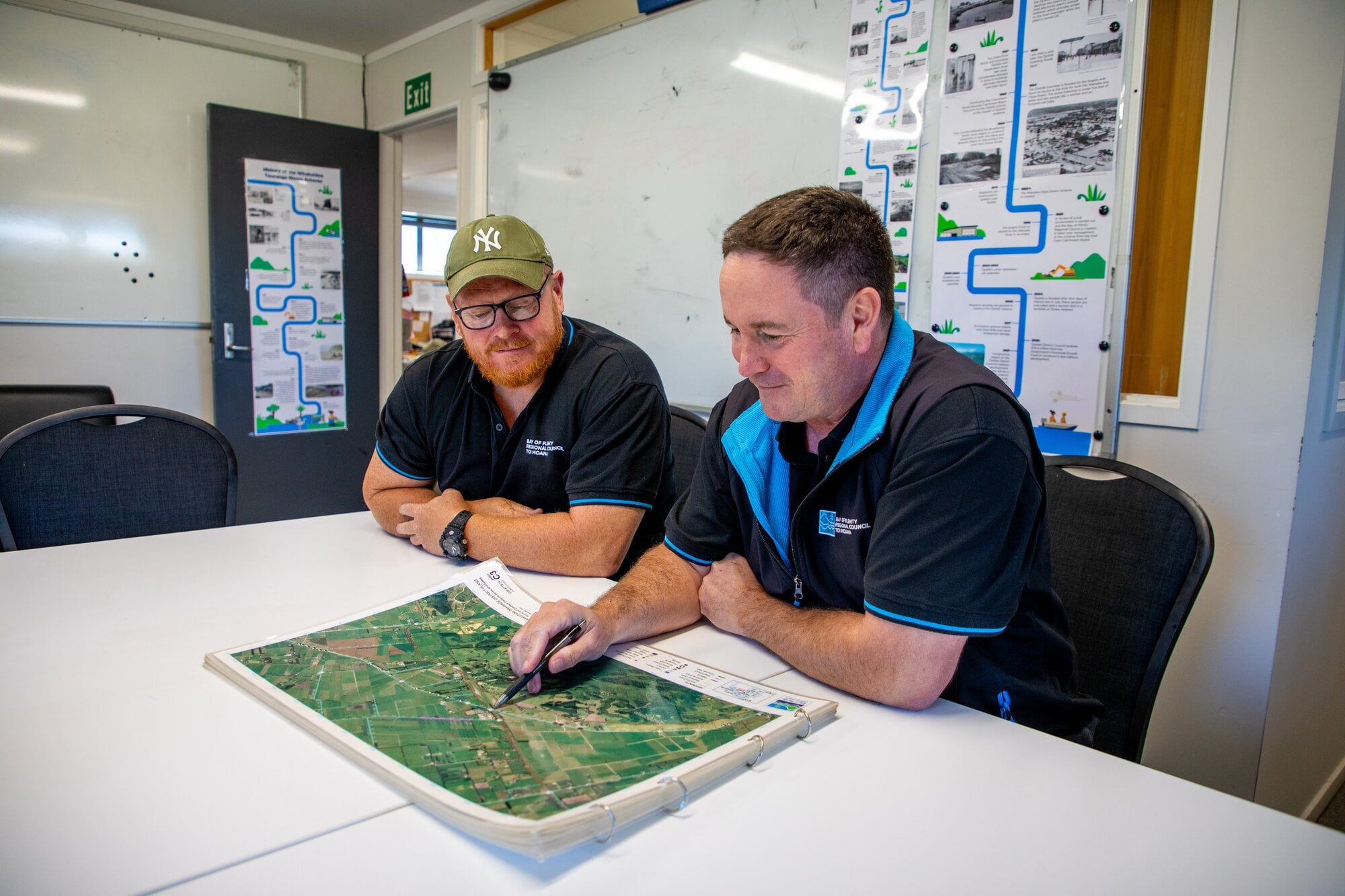
Dan Batten, on right, showing Kerry Smith a map of the Kaituna Control Scheme. Photo / Ross Campbell
Batten’s journey at the regional council is like many on his team. In his mid-20s, he was working as an earthworks contractor before accepting a permanent role as a machine operator in the Kaituna scheme. Since then, he hasn’t looked back.
As a Maketu resident, he was proud to be the ‘boots-on-the-ground’ for the scheme – doing the work that he knew was helping to protect his neighbours, friends and family.
“The Kaituna scheme is basically my people. It’s rewarding working for the community that you live in.”
During the next decade, Batten worked his way through the ranks of the rivers and drainage operations team, trying his hand as a works foreman and works co-ordinator before accepting the manager role in 2022.
Huge knowledge depth
For some, leading the team responsible for maintaining our flood protection network might seem like a daunting task. However, the huge depth of institutional knowledge within his team is what keeps Batten grounded.
“We have guys here ranging from myself as one of the newer ones at 15 years, through to one staff member coming up 50 years of service. We know the land, we know the landowners, we know the schemes.
“This team has seen it all before and no doubt we’ll see it again. We know how to respond and be in the right place at the right time.”
One of the biggest challenges Batten faces is managing what needs to be done with what’s practical. With more than 54,000 ratepayers relying on the rivers and drainage operations team, the work never slows down.
“On a sunny day, when we’re out in the field working on boats and diggers, there can be a bit of envy,” he said.
“But when the weather changes, the pressure does come on. There’s pressure all day, every day, to accomplish things in a short timeframe between the weather, fish spawning, bird nesting season and everything else.”
Safe, necessary, affordable
It’s also up to Batten’s team to balance what’s safe, necessary and affordable when it comes to how best to manage the maintenance of our flood defence infrastructure.
“We do take everyone’s views into consideration. But the infrastructure is here for a reason and we need to make sure it’s up to scratch so it can provide that level of service.
“So, when we’re saying ‘no’ to certain operations near our infrastructure or asking someone to move their stock off the stopbank, it’s not us being pushy, we’re just ensuring our flood defences don’t incur unnecessary damage and can perform to the design standard when required.”
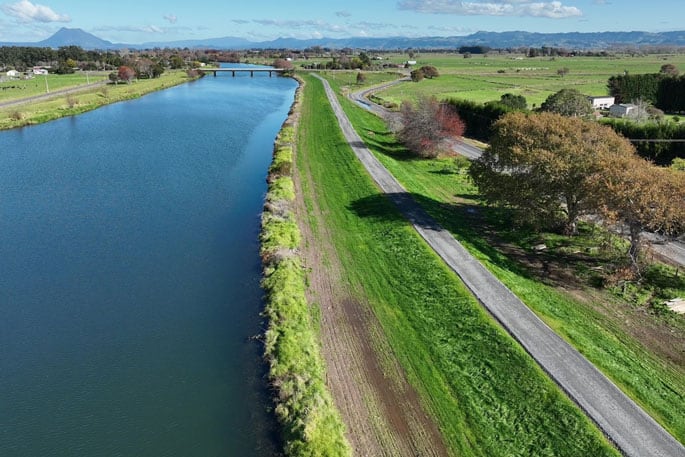
The lower Rangitaiki River stopbanks. Supplied photo.
Despite the challenges, working with the community remains a rewarding part of the job.
“We’ve been working closely with landowners, iwi, hapū and other community members on environmental enhancement work to improve fish passage, inanga spawning and water quality,” Batten said.
“It’s good chicken soup for the soul to be able to provide that service.”
The people
For Batten, the real strength of the Bay’s flood protection network lies not just in the infrastructure, but in the people who care for it and the communities it helps protect.
With a changing climate and new technology reshaping the way the team works, he knows their role will continue to grow. But what gives him confidence is the depth of knowledge, dedication and genuine care within his crew.
“I’ve seen these guys in some pretty high-pressure situations. Up and on the job at 2am in the pouring rain. Working with this group has just been an absolute privilege and a pleasure over so many years.”
Whether they’re responding to a storm, repairing damaged assets, carrying out maintenance tasks or working alongside landowners, iwi and hapū to enhance waterways, Batten said that sense of purpose never changes.
“At the end of the day, it all comes back to people. That’s what drives us every day – no matter the weather.”