
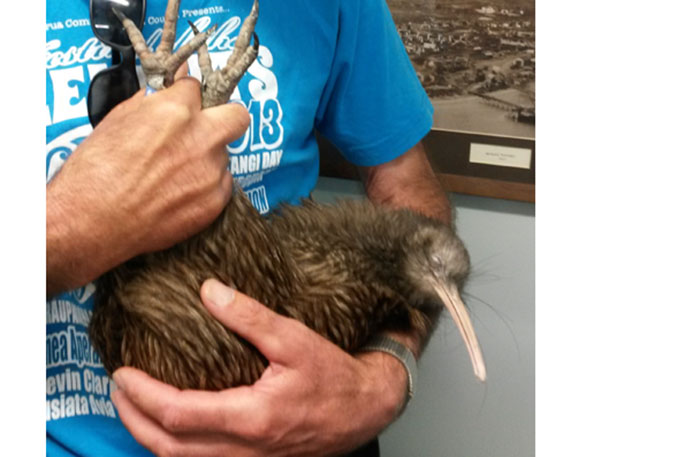
There's restrained optimism brewing in the bush at Otanewainuku Forest 20km south of Tauranga.
A bloke called ‘Kowhai' is sitting on an egg. 'It's late in the season. We weren't expecting it so it's a nice surprise,” says Otanewainuku Kiwi Trust's Harry Taylor.
A birth is still a way off and the trust knows to be pragmatic. To make the point, this egg does not have a name.
'We have learned not to get too attached to an egg,” says Harry. That's because nature has a mind of its own and things can go wrong.
‘Kowhai' is holed up in a burrow under a ponga log. They know he's sitting on an egg because the radio transmitter on his leg has switched to incubation mode.
When he's active it bleeps every few seconds. But the signal has changed because he's stationary. He's sitting on an egg and it's difficult not to get excited about the egg and impending birth.
'Yep definitely,” says Harry. That's why the trust does its work. 'It shows the breeding programme we have got going down is effective and working. That's what all the effort is about so it's great when it happens.”
Ten-year-old Kowhai arrived at Otanewainuku from Nga Manu Nature one year ago and struck up with a local girl called ‘Ngaire'. It's assumed this egg belongs to her. They've already produced an egg and the male chick was called ‘Sartor'.
It takes the kiwi 30 days to produce an egg – a whopping 120mm long and 80mm in diameter and six times bigger than normal for a bird of its size. The egg grows to take up 15 to 20 per cent of her body mass and her pregnant belly bulges to the point it touches the ground.
When the egg was laid, Ngaire's work would have be done. Just one egg in the clutch, before a dutiful Kowhai would have stepped up to do the incubating – a process taking 70 to 80 days. Then the trust takes control.
Most kiwi chicks won't survive in the wild because of predators, so just before hatching the egg is uplifted from Kowhai's care and taken to Kiwi Encounter near Rotorua.
'No, we aren't destroying any paternal bond,” explains Harry. In the wild, as soon as the egg's hatched, the chick is up and off. 'It's not like a dog which hangs around socialising with its parents.”
When the chick is three times it's birth weight, of about 300grams, and capable of fending for itself, it'll be released back into the forest at Otanewainuku.
Then perhaps a name will become an issue. Before it have gone Puke Manu, Granite, Kaha, Pistachio, Gallipoli and Te Hoe. There were more than one hundred suggestions for the last kiwi born. Patupaiarehe, meaning a pale spirit that lives deep in the forest, was the name chosen. It'll be Patu to its mates.
But this is all putting the kiwi before the egg – and that doesn't always bode well. This season has so far produced three or four new kiwis at Otanewainuku. The trust is banking on Kowhai delivering another.