
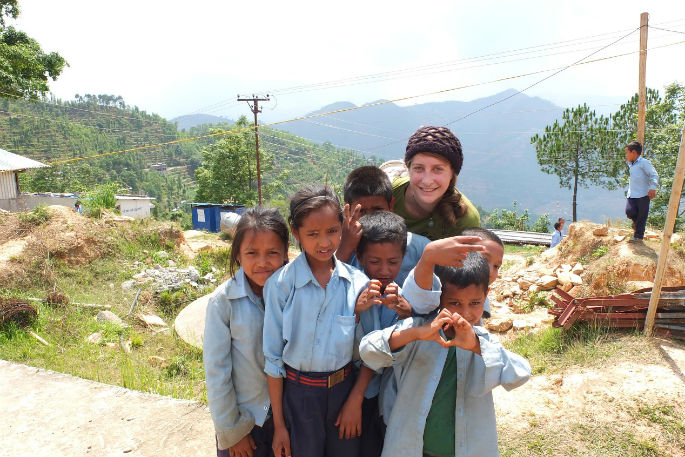
Stephanie Harper comes from the beautiful seaside suburb of Mount Maunganui, where she's used to ending the day on a full tummy and easy access to clean tap water when parched.
It's a lifestyle foreign to her new neighbours in Nepal, where the 28-year-old has been living for the last three months, more than 12,000km from home.
'It's completely different,” says Stephanie. 'A staggering 42 per cent of the population live below the poverty line and only 27 per cent have access to sanitation.
'Clean water and food is something of a luxury here – not so much in the tourist areas, but definitely in the less developed areas.
Stephanie says as a foreigner you cannot just to go to the tap for a drink unless you have a filter bottle.
'There's a butcher down the road from where I'm staying and the chicken they sell is left out on a table, in the sun, right next to a very busy, dusty, polluted road, uncovered, all day long, until it's all sold.”
The registered nurse moved to Nepal in March after her first visit in November, 2015.
'I fell in love with the culture, people and the strong sense of community they have here.
'I've witnessed so many beautiful acts of kindness here – and had them bestowed upon me –from people who, financially speaking, have very little.”
Stephanie also fell in love with Bishal from Kathmandu, who she met in Nepal last year.
Bishal established the not-for-profit organisation, Supporting Hands Nepal, which is currently raising funds for a local community in the Sindhupalchowk district to ensure the Nepalese have access to clean water every day – and Stephanie joined as an administrator.
'I consider myself to be an extremely fortunate person in every possible way and I believe my good fortunes should be put to use by helping those less fortunate than myself,” says Stephanie.
It's been one year since a magnitude 7.8 earthquake struck Nepal, killing nearly 9000 people – and Stephanie says unfortunately there are still thousands of Nepali people living in makeshift shelters with no electricity and poor access to water.
'Sindhupalchowk was the worst hit region, with more than 80,000 homes destroyed and 95 per cent rendered inhabitable.
'The main water source in Barkobot village dried up after the earthquake. Now the 470 villagers have to collect water from a tiny pipe that literally trickles out – taking more than an hour to fill a 20 litre container. This water is for drinking, bathing and cooking.”
The couple hopes to raise $70,000 to help 2200 people in Barkobot and neighbouring villages.
'All over the country people are struggling to access this water, and even if they can access it, it is not safe to use.
'Even here in Kathmandu, the biggest and most developed city in Nepal, the supply of water to household taps has dropped to more than 70 million litres per day, when the demand is more than 400 million litres.”
But despite the hardships, the people just get on with it with humility and grace, says Stephanie.
'I like the challenge of living in a developing country. Day-to-day life is so different and you learn to appreciate what you thought were the small things in life – clean water, access to good health care, 24/7 electricity and safe roads.”
To donate, visit their Givealittle page