
Hot sun, the rasp of the cicadas…summer's here. That relentless drumming is the mating call of some handsome male plant bugs.
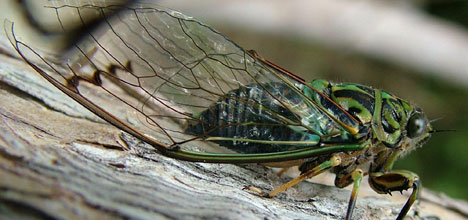
Please name me when you see me - I am Kihikihi, the cicada. Photo by Peter Hamill.
New Zealand has over 50 species of cicada, all of them endemic (specific to NZ), with more elsewhere. Our species are widely distributed, from sand dunes and cities to forests and mountains. The large Chorus Cicada, wingspan up to 80mm, body length of 26mm, is one of the commonest. The Maori name for this one is kihikihi wawa, ‘like the roaring of heavy rain (wawa)'. But even the small green cicadas can, en masse, produce 100 decibels of strident noise – that's like standing about a metre from the disco speakers!
Cicadas live on plant sap. Adolescents spend up to five years up to a metre underground, injecting saliva down one tube of their hypodermic-like mouthparts into a plant root and sucking up the semi-digested sap through another. Eventually, some signal triggers their journey to the light. The pale larvae, or nymphs, climb up, and shed their final exoskeleton. Take a close look at the empty cases clinging to a tree trunk. You can see every detail, their front digging legs, the tubes that transported oxygen into their bodies.
The emerging cicada pauses while the veins of its crumpled wings fill with fluid and stiffen, and then it has a few brief weeks of summer freedom. Music, sex and food (or is sap better described as drink?) are the agenda. The male has a pair of tiny ‘drums' just behind the wings. Special muscles vibrate these at up to 300 cycles per second to serenade the female of his species, the stereo hearing organs on her abdomen alert to identify his whereabouts. Listen for different rhythms – each species has a quite distinct song. Clapping cicadas also beat time with their wings on branch or ground.
After mating, the female deposits eggs in plant stems, some species in a characteristic herringbone pattern. The tiny nymphs that emerge fall to the ground, dig down and the cycle goes on.
Gardeners and orchardists may curse the cicadas when stems weakened by the egg-laying scars break in the wind, but cicadas provide food for birds and other invertebrates. Their abundance indicates a healthy soil. If they sometimes seem over-abundant, that may be an indication of an imbalance in our natural world, a loss of the creatures that should keep them in check.
Please name me when you see me - I am kihikihi, the cicada.
By Forest & Bird Kaimai Mamaku Campaign spokesperson Eila Lawton