
 |
Brian Rogers Marine Musings www.sunlive.co.nz |
It has been a tragic week on the water. The death of a boatie in the harbour, after a runabout inexplicably ploughed into the western A channel beacon, is a horrible reminder of why all boaties need to keep focused on driving, pay attention and watch their speed in close confines and near shore.
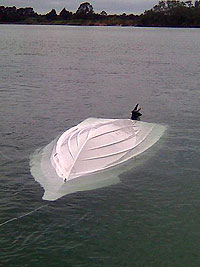 Not that we know the cause of the crash yet. We may never know. But the result has devastated two families and had a profound effect on those of us involved in the aftermath.
At first I didn't want to write about this experience, but I am compelled to publicly praise the many who did good; and also a mention of the screw ups.
On Monday, Claire and I had just returned from a coastal passage from Whitianga, aboard the Waterline Magazine Sealegs amphibious 6m RIB. We'd pulled into the driveway and were unloading when we heard the mayday call on CH16 and the plea from Coastguard for boats in the vicinity to help search for a missing person.
We replied that we were 10 minutes from the scene. The fast response capability of the amphibian means we could launch and be on the scene faster than any other craft.
We arrived off Rangiwaea Island to find the upturned boat tied to the Farr 6000 trailer yacht Windrose.
Graeme Wallace and Don Wallis had sailed from Katikati on their way to Tauranga when they saw the runabout smashed into the marker posts. With the help from a nearby ketch, did a great job of getting the injured skipper, Keith Longley (65) of Omokoroa, aboard; and secured the wreck, which had since capsized.
With cool heads, they'd also effectively relayed plenty of vital information to Coastguard, who had very quickly mustered assistance.
Don and Graeme were trying to get the incoherent skipper to remember, in his shocked and concussed state, who, if anyone, was aboard with him. He'd told them his wife might have been on the boat.
On our arrival we were expecting to join part of a grid search for the possibly missing person when the pilot boat despatched crewman Dave White to search the wreck. He does not normally work on the pilot boat, but was relieving for the day. He stripped off and jumped overboard to swim under the wreck to check for survivors.
After several attempts he resurfaced with a body and signalled us over. At this stage, the victim would have been underwater in the submerged bow of the boat, for at least 20 minutes, probably longer.
Injured skipper Keith, seeing his companion, commented 'It's Richard.”
Claire and I hauled the body aboard the Sealegs and Dave climbed in. Dave and I commenced CPR; despite the victim's massive head injury and other signs; plus length of time submerged, suggesting that there was little hope.
It was clear after some time that these efforts were futile and we were instructed to stop.
The Coastguard jet boat with Simon Barker at the helm had arrived during this time and attended to the injured skipper.
Calvin Sing took charge of the situation and soon made arrangements to return the injured man to medics at the marina, and the body was taken on the Sealegs up the marina ramp to the police onshore to start their investigation.
On the way we passed the Skookum barge on its way to assist.
The wreck was towed to Bridge Marina and lifted from the water.
The Swiss ketch, meanwhile had run aground on the nearby sandbar during its attempts to assist, and the couple aboard remained aground there until the rising tide late into the night.
The deceased was named as Richard Evans, a Canadian national, who was a week into a two-week holiday here with his wife. Read more about him here.
Keith was taken to Tauranga Hospital with serious injuries. By midweek he was reported to be in a stable condition.
The western A channel marker was recovered from the harbour the next day – both of the massive wood piles had been snapped off just above the seabed and there were portions of a fibreglass boat embedded into the timbers. It was brought ashore at Tauranga Bridge Marina as part of the investigation. The channel mark has since been replaced with a temporary buoy in the meantime.
The operation from my point of view was extremely well handled, so many people responded with speed and clear heads; the information from those first on the scene and their quick action in helping Keith was commendable.
The Coastguard and police were supportive and comforting for those dealing with a horrific scene and consequences.
My heart goes out to the families of this tragedy and those others who have been affected.
Dave particularly, who risked much in diving under the wreckage to retrieve Richard. That man deserves an award.
Coverage of tragedy on the harbour
While the search and rescue mission this week on the harbour by volunteers went like clockwork, there was one aspect of the tragedy that went horribly wrong.
The fly in the ointment, was some shoddy reporting locally. While SunLive carried fast, accurate and informative news coverage, the same can't be said for others.
It's not often a news organisation is involved on the inside, and can report from the perspective of a person at the heart of the incident.
The poor performance was the woeful reporting from the Bay of Plenty Times.
It's not always easy to get the facts and occasionally anyone can get it wrong. But the mistakes in the daily paper's coverage were so far removed from fact that I wondered if we were talking about the same crash. Worse, they weren't attempted to be corrected in subsequent editions.
It casts serious credibility issues on the reporting quality of the paper. It also makes it tough for all other media when some are so loose with reality.
Firstly, they described the vessel as a jet boat, even after photos were published from the scene, clearly showing the bottom end and prop of the Mercury 150hp outboard sticking out of the water at the stern of the capsized runabout. It was still called a jet boat on web reports, even days after this was clearly wrong.
They reported the crash into 'two large wooden pools” (we assume they mean poles or piles) happened at Motutangaroa Island. In reality, it wasn't even close; Motutangaroa is an obscure sand bar several miles to the north and completely unknown to the average reader. (Journalism by Google). The crash actually occurred when the boat collided with western A channel marker, between Motuhoa and Rangiwaea Islands.
The injured skipper was reported to be from Welcome Bay. In fact, Keith Longley is a well known identity from Omokoroa – and was returning to there, after a fishing trip – about as far the wrong side of the district as you can get.
The BOP Times also quoted a skipper of a 'passenger barge”, (in reality, it is a roll-on, roll-off vehicle ferry) with inaccurate assumptions of what had happened. Including that the search for survivors under the boat started when the Coastguard arrived. Wrong. We had Richard onboard and were administering CPR when the Coastguard arrived.
Assumptions, also, because we passed that barge while it was heading to the scene, when my boat with the deceased aboard and the Coastguard boat, with the injured man, were well on our way back to Sulphur Point.
There were other details, so obviously wrong, that we don't have the space to document here. But overall the credibility of some news organisations is clearly at rock bottom.
The public only see some of the errors and inconsistencies. Some are so blatantly wrong, however, they're hard to miss.
Furthermore, Bay Times reporters at the scene avoided talking with Claire and myself – who were significantly involved in the whole tragic process – presumably because of our ownership of a ‘competing' media organisation. Not that I care; we had the story straight in SunLive. The point is, it's censorship of the news for the sake of pettiness; and it's not the first time. (Bond Store gains highest category historic rating; Sun Media wins business award etc) In fact, the whole role of the Waterline Sealegs and the retrieval of the deceased; the CPR efforts and delivery of ashore was notable by its absence.
You can guarantee however, that should any of the Rogers family be in the news for the wrong reasons, we'd be all over the pages of that paper like a rash.
You need to know that in some cases the news is obviously skewed for political/commercial reasons.
The public needs to know that some media sources are more credible than others. Even the sister publication, the NZ Herald, managed a balanced and accurate report and got the facts correct. Yet they have no supposed ‘local knowledge' and weren't even there!
Careful reporting can still be done long distance, with good journalists.
Wrong information is not only frustrating for readers, in this case it is distressing for the surviving family and friends and those closely involved in tragic circumstances.