
 |
Andrew von Dadelszen Former Regional Councillor |
The regional council can be rightly proud for being the first to mechanically remove mangroves from our harbour.
This week's Operations Committee has received a report that boasts the successful removal of 110 hectares of mangroves – of a total of in excess of 900 hectares of this pest. The challenge for regional councillors is how to manage the exponential spread – estimated to have the potential to grow to 2000 hectares – if further interventions aren't initiated.
Mangrove removal is an expensive exercise, but should be seen within the perspective that: a) there is overwhelming community support for containing and in fact reducing mangrove distribution, and b) that through the revenues created from dividends from the council's shareholding in the Port of Tauranga, there should not be a funding constraint. If you take the thesis that putting back a few hundred thousand dollars into a harbour that generates around $25 million annually to the regional council, this appears reasonable to me.
The staff report to the Operations Committee is only offering containment – and minimal removal to tidy up the current mangrove boundaries – and no continuation of any substantial mangrove reduction in the next three years. For me, I would like to see a much more bold approach.
Getting consent to remove a further 100 hectares as soon as possible would seem to be the least that our community should accept. I don't think that many people are asking for every last mangrove to be removed, but we should be aiming at getting mangrove levels back to where they were in the mid 1970s – see attached graph – as a bare minimum.
I applaud the regional council for continuing to look at mechanisms to remove not only mature mangroves, but also seedlings. This is a battle that won't be easy to win, but we must keep going to protect our visual amenity, recreational access and to prevent the further loss of kaimoana – all at threat from this rapid mangrove spread.
Research into mechanical seedling removal is applauded, but let's not give up on the big challenge – turning back the degradation of our harbour. Your regional council has been magnificent in getting the mechanical removal process successfully proven and now is not the time to take the foot off the pedal.
If you have a view on these or any other local government issues, I invite you to email andrew@vond.co.nz
Mangrove canopy cover within a number of estuaries in the Tauranga Harbour.
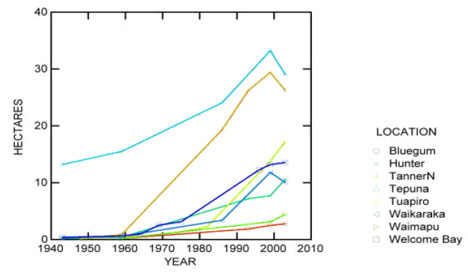
SOURCE: Park (2004) Aspects of Mangrove Distribution and Spread in Tauranga Harbour.
Environment Bay of Plenty Environmental Report 2004/16.