
 |
Brian Anderson The Western Front www.sunlive.co.nz |
It's really quite easy –one foot after another. You have to start an hour or two below high tide, negotiate a muddy patch on the shore at the end of Matahui Road and walk to Matakana Point.
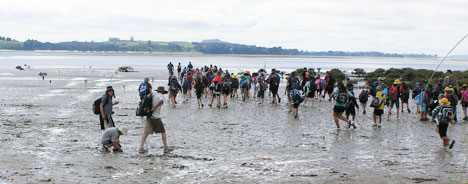
Three kilometers out from the shore, there might be a few misgivings. You might feel a little vulnerable. Don't worry. The Matahui Bank is quite wide and if you wear your Polaroids you will be able to see the bottom of the shallow puddles and be more sure footed. Two hours before low tide, the deepest water was just over my knees. It is obviously a walk for a group. There would be a real feeling of isolation on your own and three kilometers away from any shore. There is no rush. Our group met the other half of the Katikati Primary School senior school on Matakana Point walking the other way. They started from Omokoroa and walked back to Matahui on the same low tide.
It is not like walking in the hills where new vistas are suddenly revealed. Most of us recognised the alternate views of our home areas. Matakana beaches were new to most and with Pohutukawas tumbling down off the hills there are many tempting places to linger if your timetable allows. In the harbour the problem of the mangroves was evident. A few juvenile mangroves were seen out on the bank and if they ever took over it could change the whole character and hydrology of the harbour. There was a rumour that a number of locals have been seen dealing with the problem.
Unfortunately, at the moment, there are not enough pole markers to attempt a trip without a guide. The Council had started to remove the remaining telegraph poles because the stumps particularly were seen as navigation hazards. Thanks to requests through the Tauranga Harbour Recreation Forum, work is now starting on securing enough poles to allow us to retain the Matahui Heritage Trail markers.
I knew about the trail but it wasn't until after my first crossing, in the company of over a hundred primary school children, that I became aware of how important the Recreation Forum's decision had been for the Northern Harbour. Our guide Kereama Bluegum, is a teacher from the school and comes from the Te Rangihouhiri Marae on Matakana. In his early years, he was also the last of the cream cart drivers who brought the cream across the bank from Matakana to the dairy company in Kataikati. Stories of cattle drives and mustering sheep across the harbour started to become real. I have tried to find books on the Matakana but there are very few. The heritage seemed to be within the families of the children walking beside me and I learned more from the respect the children had for the opportunity and their family stories that they were sharing.
The Te Rangihouhiri marae on the Point at the end of the trail has special significance for Maori of the area The name Ngâi Te Rangi is an abbreviation of 'Ngâti Te Rangihouhiri” the descendents of their ancestor Te Rangihouhiri. Horse riding and other groups have had association with the marae over the years and walking the trail together has been a meeting point for all of the people of the area. With an imminent ‘Whole of Island Plan' being undertaken by the District Council, we hope that, in any consultation, that the voices of the different hapu and our shared local heritage are preserved.
Over the years, the school has taken many students on the Matahui Trail. After six years in Katikati, I felt I could identify with the town but there was something special about the walk when I found that just about all of the adults with the children had already walked the trail. It became obvious that the Matahui walk was almost a rite of passage for belonging to Katikati and a necessary element for understanding the Northern Harbour. It was soon evident that every student saw the walk as a highlight of their school year. I have supervised many large groups of children but this was the only one where I never heard one complaint.
As visitor to the Bay over the years we always climbed Mauao and appreciated Matakana from a distance. We heard of threats to develop the land for big hotels thirty years ago and were horrified. When we worked in England, I carried postcards of the view from Maouo of the Mount and Matakana and told everyone that was where we lived. After the walk and the trip back to the ferry, though I have always appreciated the harbour and Matakana, you don't really know how important the area is for the Bay until you have walked Matakana and, even more, until you have walked the Heritage Trail.