
 |
Weather Eye with John Maunder |
Carbon dioxide is a colourless, odourless gas vital to life on Earth. This naturally occurring chemical compound is composed of a carbon atom covalently double bonded to two oxygen atoms. Carbon dioxide exists in the Earth's atmosphere as a trace gas at a concentration of about 0.04 per cent (400 ppm) by volume. Natural sources include volcanoes, hot springs and geysers and it is freed from carbonate rocks by dissolution in water and acids. Since carbon dioxide is soluble in water, it occurs naturally in groundwater, rivers and lakes, in ice caps and glaciers and in seawater. It is present in deposits of petroleum and natural gas.
Atmospheric carbon dioxide is the primary source of carbon in life on Earth and its concentration in Earth's pre-industrial atmosphere since late in the Precambrian was regulated by photosynthetic organisms and geological phenomena. As part of the carbon cycle, plants, algae, and cyanobacteria use light energy to photosynthesize carbohydrate from carbon dioxide and water, with oxygen produced as a waste product. Carbon dioxide is produced by plants during respiration.
Carbon dioxide is a product of respiration of all aerobic organisms. It is returned to water via the gills of fish and to the air via the lungs of air-breathing land animals, including humans. Carbon dioxide is produced during the processes of decay of organic materials and the fermentation of sugars in bread, beer and winemaking. It is produced by combustion of wood, carbohydrates and fossil fuels such as coal, peat, petroleum and natural gas.
Carbon dioxide is an important greenhouse gas. Burning of carbon-based fuels since the industrial revolution has rapidly increased its concentration in the atmosphere. It is also a major cause of ocean acidification since it dissolves in water to form carbonic acid.
Source: Wikipedia
The annual mean growth of Carbon Dioxide at the Mauna Loa Observatory in Hawaii is shown in the following chart.
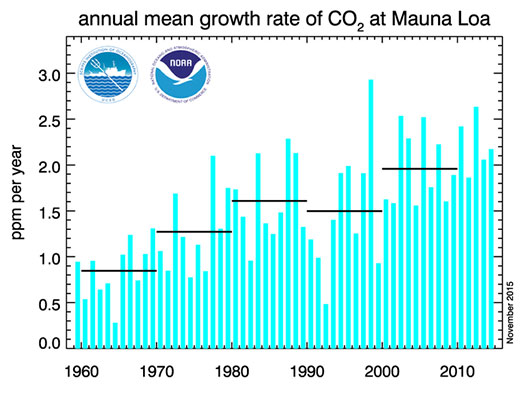
The graph show the annual mean carbon dioxide growth rates for the Mauna Loa observatory in Hawaii. In the graph, decadal averages of the growth rate are also plotted, as horizontal lines for 1960 through 1969, 1970 through 1979, and so on.
The annual mean rate of growth of carbon dioxide in a given year is the difference in concentration between the end of December and the start of January of that year. If used as an average for the globe, it would represent the sum of all carbon dioxide added to, and removed from, the atmosphere during the year by human activities and by natural processes. There is a small amount of month-to-month variability in the carbon dioxide concentration that may be caused by anomalies of the winds or weather systems arriving at Mauna Loa.
Source: NOAA
For further weather and climate information see: https://sites.google.com/site/theuncertaintybusinessclimate/