
 |
Peter Blakeway Food writer |
The average time spent cooking a family evening meal is now only 34 minutes.
This is compared to people spending a full hour in 1980.
People can change things if they want to. If we look overseas, we can see how successful other countries have been in protecting their indigenous food cultures. The French Government actively supports la semaine du gout in schools, which is a week of food and culinary activity designed to stimulate interest in cooking and eating among children.
The French authorities make very sure they keep alive their markets, their small producers and their specialist retail shops, using planning and competition law to safeguard them. Before a supermarket can get planning permission to develop a new site, there is a public inquiry, which has to examine the whole area of public interest.
Food and public interest are seen as synonymous.
Good food in Italy is taken as the natural prerogative of every citizen.
They talk about food in much the same way as we do about the weather; what they ate yesterday, what they will eat tomorrow, and whether it will be as good as what they are eating today.
The Italians have fought to preserve their food culture. Food is a source of cultural identity.
This is not simply a matter of government decree, but involves the active responsibility of every citizen. It is still the norm to for Italians to sit down together at least once a day, to eat food cooked at home.
As a consequence, their children are gastronomically literate. They know the difference between good and bad food. More importantly, they are civilized and socialised.
Of course, we can say we are not like the Italians. Indeed we are not.
They seek to preserve their food culture. We are – or should be – trying to create one. The point is we can create one. If you consider just how dire our food culture was 50 or even 15 years ago, we can see just how far we have come. The trouble is we started from a very low base and there is still a very long way to go. But at least we have made a start.
It is now a matter of mobilising wider and wider public involvement.
Support is not enough. It is necessary to act, to shop, to cook, to eat consciously, to take pleasure in something we have to domat least once a day, preferably twice and even three times.
And stop treating food as a pit-stop – a refueling to give us the energy for more important matters.
Food is a more important matter. As Carlo Petrini, the president of Slow Food, the international organisation set up to protect culinary cultures and social and bio-diversity, put it: 'When I wear a pair of Armani pants they do not become a part of Carlo Petrini. But when I eat a slice of ham, it becomes a part of Carlo Petrini. That's why I care about food”.
And when you consider the appalling byproducts of bad food and bad eating habits – widespread obesity, diet related diseases, social malfunction – we should not just count the cost to society, but to ourselves. And if we look on cooking, not as a duty but as an essential, and food, not as fuel but as a pleasure, then we might give supermarkets and politicians something to think about.
Speedy pasta
Serves 2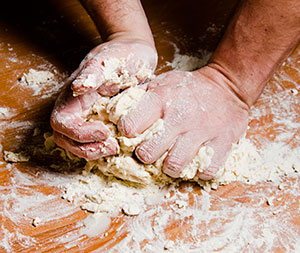
200g pasta ‘00' flour
2 eggs or 4 egg yolks
Method:
Sieve flour into a bowl. Add whole egg and combine mixture with finger tips. Turn out onto a floured work surface and knead into a dough. If possible, rest in refrigerator for at least 30 minutes.
Roll out onto floured board into a rectangle. Next, flour surface of pasta and, using both hands, roll rectangle into a Swiss roll shape. Use a sharp knife to cut into desired thickness. For example, tagliarini (thin), tagliatelle (medium) or parpadelle (thick).
Tagliatelle with chicken & green beans
Serves 2
1 x 200g chicken breast, thinly sliced
1 Tbsp extra virgin olive oil
1½ garlic cloves, finely sliced
Sea salt & freshly ground black pepper
1 batch tagliatelle (see ‘speedy pasta' recipe above)
1 Tbsp olive oil
100g baby green beans, topped (not tailed) and
sliced from end to end on the diagonal
65ml (¼ cup) chicken stock
Good quality parmesan cheese, grated
25g basil leaves
Method:
Place the chicken, extra virgin olive oil and garlic in a bowl and stir to combine. Season with salt and pepper. Cook pasta in a large pot of rapidly boiling salted water until ‘al dente' and drain well. Meanwhile, five minutes before pasta is cooked, place a large frying pan over a high heat until hot. Add olive oil and heat for five seconds. Add chicken with marinade and sear quickly for 30 seconds. Add beans and reduce heat to medium. Cook for another two minutes, stirring occasionally. Return heat to high, add the stock and simmer for 30 seconds.
Add pasta and toss to combine.
Divide pasta evenly between two bowls and top with freshly grated parmesan cheese, basil and freshly ground black pepper.