
 |
Weather Eye with John Maunder |
There is an excellent website compiled and updated monthly by Dr Ole Humlum, who is a Danish professor of physical geography at the University of Oslo, and adjunct professor of physical geography at the University Centre in Svalbard.
See http://climate4you.com, the following is complied from his website.
Planet Earth has an age of about 4600 million years.
Global climate change has been the rule for the entire history of Earth, not the exception.
If each year of planet Earth is represented by one millimetre, the entire stratigraphic history would be about 4600km long.
In North America, 4600km corresponds to the distance between San Francisco and Quebec City. On this scale modern humans would appear within the last 200 m, the polar bear within the last 150 m, and the entire global meteorological record since about 1850 would take up the last 160 mm.
From time to time the Earth has been affected by millions of years with relatively cold climate, each such period leading to a long succession of glacial and interglacial periods.
During the last couple of millions of years, planet Earth has been in such a cold stage.
The last (until now) ice age ended around 11,600 years ago, and we are currently living in a so-called interglacial period, until the next ice age which presumably will begin some time into the future.
The last four glacial periods and interglacial periods are shown in the diagram below, covering the last 420,000 years in Earth's climatic history.
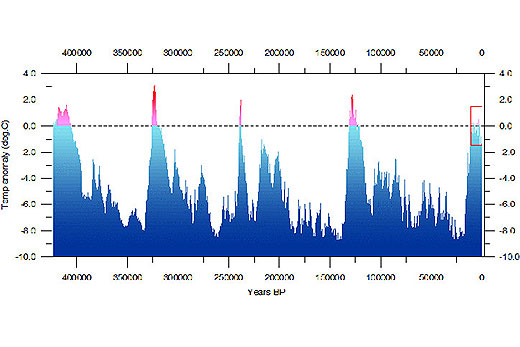
The diagram above shows a reconstruction of global temperature based on ice core analysis from the Antarctica.
The present interglacial period (the Holocene) is seen to the right (red square).
The preceding four interglacials are seen at about 125,000, 280,000, 325,000 and 415,000 years before now, with much longer glacial periods in between.
All four previous interglacials are seen to be warmer (by 1 to 3 degrees Celsius) than the present.
The typical length of a glacial period is about 100,000 years, while an interglacial period typical lasts for about 10-15,000 years.
The present interglacial period has now lasted about 11,600 years.
According to ice core analysis, the atmospheric carbon dioxide concentrations during all four prior interglacials never rose above approximately 290 ppm; whereas the atmospheric carbon dioxide concentration today stands at nearly 390 ppm.
The present interglacial is about 2 degrees Celsius colder than the previous interglacial, even though the atmospheric carbon dioxide concentration now is about 100 ppm higher.
For further information on a variety of weather and climate matters see:https://sites.google.com/site/doesgodplaytheclimatedice/